Italiano · English · Français · Deutsch · Español · Русский

Regression hypnosis: where it really comes from

Italiano · English · Français · Deutsch · Русский · Español

Anyone searching for “regression hypnosis” is looking for a precise idea: that there is a state, different from waking, in which memories come back that cannot be found when awake, and that in that state one can go back to the oldest memory, the one where a disorder began. This idea is not modern. It is more than two hundred years old, and it was put together one piece at a time, by different people. This article tells those pieces, in order.

The thread, in five steps

  1. 1784. A sleep-like state is discovered in which a person talks and reasons, and on waking remembers nothing.
  2. 1813-1823. It is noticed that in that state things long forgotten also come back.
  3. 1819-1843. It becomes clear that no mysterious force is needed: what counts is the person who enters that state. And people learn how to make that person carry the memory over into waking.
  4. 1898-1904. A physician uses that state to go back, memory after memory, to the origin of a symptom.
  5. 1919-1950. The method works only sometimes. In 1950 someone tries to keep the going back and drop the hypnosis.

1784First step: a state in which one is another person

We have to start with Franz Anton Mesmer, a German physician working in Paris. Mesmer was convinced that there was an invisible fluid, “animal magnetism”, and that illness came from an imbalance in it. He treated patients in groups, seated around a large wooden tub filled with water and iron filings, the baquet, from which metal rods came out to be placed against the body. The sign that the cure was working was the “crisis”: convulsions, screams, fainting. In 1784 a royal commission, whose members included Benjamin Franklin and Lavoisier, concluded that the fluid did not exist and that everything was an effect of the imagination.

In the same year a pupil of Mesmer, the Marquis de Puységur, on his estate at Buzancy in northern France, obtains something different. He is treating a twenty-three-year-old peasant, Victor Race, with Mesmer’s method, which at the time was called “magnetizing”: the physician sits facing the patient, stares at him and slowly moves his hands along the body, from the head downwards, without touching it or barely brushing it, convinced that he is passing the fluid into him. These were the magnetic “passes”. Instead of convulsions, Puységur sees this:

“What was my surprise to see this man fall peacefully asleep in my arms, without convulsions or pain!… he talked, he busied himself aloud with his affairs… the next day, no longer remembering my evening visit…”

«Quelle fut ma surprise de voir… cet homme s’endormir paisiblement dans mes bras, sans convulsions ni douleurs!… il parloit, s’occupoit tout haut de ses affaires… le lendemain, ne se souvenant plus de ma visite du soir…» — Puységur, Mémoires, 1786 ed., pp. 22-23.

Victor asleep seems more awake than Victor awake: he reasons better, he understands faster. But when he wakes up he knows nothing of what he has said and done. This is the first piece of the idea: there is a state different from waking, and between the two there is a wall of memory. It was called “artificial somnambulism”. The word “hypnosis” would arrive sixty years later.

1813Second step: in that state forgotten things come back

Thirty years later a Parisian naturalist, Joseph Deleuze, collects the cases and notices that the wall works in both directions. When awake, one does not remember the sleep; but in the sleep one remembers things that had been lost while awake:

“He finds again in his memory the recollection of things he had forgotten while awake… [and on waking] these two states are as foreign to each other as if the somnambulist and the waking man were two different beings.”

«Il retrouve dans sa mémoire le souvenir des choses qu’il avoit oubliées pendant la veille… ces deux états sont aussi étrangers l’un à l’autre, que si le somnambule et l’homme éveillé étaient deux êtres différens.» — Deleuze, Histoire critique du magnétisme animal, vol. I, pp. 186-187.

One example he gives: a young man had lived for two years on Crete and, when awake, no longer remembered the language; in somnambulism he said it would come back to him if he had someone in front of him who spoke it, and meanwhile he recited from memory a long English poem “exactly as if he were reading it”. Deleuze’s explanation is a single sentence: “all the sensations we have felt in the course of our life have left traces”.

Ten years later the physician Alexandre Bertrand adds a case that shows how to read these phenomena. A somnambulist “prescribed” medicinal plants that she did not know when awake, and it looked like a marvel. Then it came out that as a child she was the daughter of a herbalist and used to go with her mother to gather them. It was not a mysterious gift: it was a childhood memory resurfacing. This is the second piece: in that state old memories resurface, even those believed lost.

1819-1843Third step: there is no fluid, what counts is the sleeper

A Portuguese abbé working in Paris, José Custódio de Faria, does away with Mesmer’s theory. For him the tub, the fluid and the magnetizer’s will have nothing to do with it: everything happens in the person. To put someone to sleep it is enough to tell them forcefully “sleep!”, or to have them stare at an open hand. And he discovers that the wall of memory can be opened on command: if, during the sleep, the person is ordered to remember on waking, on waking they remember.

“[They] keep the memory of everything one wishes, as soon as they are enjoined in their sleep to turn their attention to it so as to remember it on waking.”

«…gardent la mémoire de tout ce qu’on désire, dès qu’on leur enjoint dans le sommeil d’y replier leur attention pour s’en rappeler au réveil.» — Faria, De la cause du sommeil lucide, 1819, pp. 226-227.

In 1843 a Manchester surgeon, James Braid, gives the state the name that has stuck, hypnotism, from the Greek for “sleep”. He produces it by having the patient stare at an object, and writes that “the whole depended on the physical and psychical condition of the patient… and not at all on the volition, or passes of the operator”. This is the third piece: the state belongs to the person, and what resurfaces in it can be carried over into waking.

1898-1904Fourth step: going back to the first memory

Up to this point hypnosis brings memories back, but without an order and without a precise medical purpose. The decisive step is taken by Pierre Janet, physician and psychologist at the Salpêtrière in Paris. Janet treats patients with symptoms that have no physical cause: paralyses, blindness, fits, anguish. He becomes convinced that behind every symptom there is a memory that has remained “detached”, which he calls a fixed idea. And in 1898 he describes what happens when, under hypnosis, he removes one:

“When a fixed idea has been removed, one is quite astonished to see another emerge… It is an old idea, earlier than the one just treated… and one is obliged to go back over, in reverse order, the principal fixed ideas that have tormented the patient’s life.”

«Quand on a enlevé une idée fixe, on est tout étonné d’en voir surgir une autre… C’est une idée ancienne, antérieure à celle que l’on vient de traiter… et on est obligé de repasser en ordre inverse, les principales idées fixes qui ont tourmenté la vie du malade.» — Janet, Névroses et idées fixes, 1898.

Here is “regression” in today’s sense: the memories that make people ill lie in layers, and one goes down from the most recent to the oldest. Janet also notes that the oldest are the most resistant.

In 1904 Janet publishes the case of Irène, a young woman who after her mother’s death had lost the memory of those months, and there one sees how he really works. Three things, briefly:

  • Hypnosis alone is not enough. In the first attempts Irène, hypnotized, remembers nothing more than when awake. Hypnosis only serves to keep her focused; it is the physician who guides her, memory by memory.
  • The most painful memories do not come back in their place. The others resurface in order of time; those tied to the most violent emotions are skipped, and can be faced only at the end, when the rest has already come back.
  • There is a point at which one must stop. When Irène gets close to the day of her mother’s death, she freezes and falls into convulsions. If Janet insists, the work is lost. What he asks of her is to tell those moments “in moderation, keeping her awareness of herself and of the outside world”.

In the end, the memories found again under hypnosis still have to be brought back into waking, with separate work. This is the fourth piece: a working state, a guide, an order, a stop signal. Regression hypnosis, in essence, is already all here.

1919-1950Fifth step: it works only sometimes

Fifteen years later, in 1919, Janet takes stock with rare frankness:

“In a great many instances which appear to me perfectly identical with those in which I was successful, I operated, or believed myself to be operating, in the same manner, with no result worth mentioning… there are probably to be found the germ of a therapeutic method; but we do not adequately know the rules that will make of it a method that is readily applicable.”

— Janet, Psychological Healing, trans. Eden and Cedar Paul, London 1925, vol. II, pp. 856-857 (Les médications psychologiques, 1919).

There are two problems, and they had been known since Puységur: not everyone goes into hypnosis, and what is found often stays on the other side of the wall, in the hypnotic state, instead of becoming an ordinary memory.

In 1950 L. Ron Hubbard starts exactly from here. In his article of May 1950 he writes that hypno-analysis, that is, analysis carried out under hypnosis, “sounds good in the texts but it doesn’t work”: “you can’t hypnotize everybody. Further it works only occasionally”. The book of the same month recounts that hypno-analysis and narco-synthesis, the same thing done with a drug, were studied and used as a starting point, and then abandoned: the technique it proposes is declared to be “independent of hypnotism or narco-synthesis”. The idea of going back towards the oldest memory stays; hypnosis is removed. It should be read in the light of what was known at the time, that is, of the two limits Janet had already put in writing. How that proposal was built is the subject of the article on the five threads that lead to 1950.

In a table

Piece of the ideaWhoWhen
A state different from waking, with a wall of memory on wakingPuységur1784
In that state forgotten memories come back; “all sensations leave traces”Deleuze1813
What looks like a marvel is a childhood memoryBertrand1823
No fluid; the memory can be carried into waking on commandFaria1819
The name “hypnotism”; everything depends on the patientBraid1843
Going back from the recent memory to the oldestJanet1898
The physician’s guidance, painful memories out of order, a stop signalJanet1904
Stocktaking: “the germ of a therapeutic method”, but no rulesJanet1919
The going back is kept, the hypnosis is removedHubbard1950

Related article: Before Dianetics: five threads and a knot.

Sources. Puységur, Mémoires pour servir à l’histoire et à l’établissement du magnétisme animal, 1786 ed. · Rapport des commissaires chargés par le Roi de l’examen du magnétisme animal, Paris 1784 · Deleuze, Histoire critique du magnétisme animal, vol. I (1st ed. 1813), pp. 186-191, 235-236 · Faria, De la cause du sommeil lucide, vol. I, Paris 1819 · Bertrand, Traité du somnambulisme, Paris 1823, pp. 99-106 · Braid, Neurypnology, London 1843, pp. 19-20 · Janet, Névroses et idées fixes, 1898; “L’amnésie et la dissociation des souvenirs par l’émotion”, Journal de psychologie normale et pathologique, 1904, pp. 417-453; Les médications psychologiques, 1919, vol. III; English translation Psychological Healing, trans. Eden and Cedar Paul, London, Allen & Unwin, 1925, 2 vols · Hubbard, “Dianetics: The Evolution of a Science”, Astounding Science Fiction, May 1950; Dianetics: The Modern Science of Mental Health, 1950.

The page numbers for Puységur and Faria come from period scans and may be off by one or two. Quotations from French are translated; Janet 1919 is quoted from the 1925 English translation.
Engraphy and ekphory: how an English logician translated memory in 1921

Italiano · English · Français · Deutsch · Русский · Español

In 1921 Bertrand Russell, the author of Principia Mathematica, devotes a whole lecture to an almost unknown German zoologist. He gives his terms, his definitions, his two laws with page numbers. Then he takes them apart. But by then “engram” and “ekphory” have entered the English language, in a book people actually read.

Quotations read in the originals: Semon, Die Mneme (1904, 1920 edition) and Russell, The Analysis of Mind, Lecture IV (Gutenberg edition). At the end: what is proven and what is not.

A logician reads a zoologist

In 1921 Bertrand Russell is no ordinary philosopher. With Whitehead he has written the three volumes of Principia Mathematica, he has given his name to a paradox that forced set theory to be rebuilt, and he has just come out of prison for his pacifism. The Analysis of Mind collects fifteen lectures given in London and Peking, and its thesis is ambitious: mind and matter are not two substances, but two ways of arranging the same elements.

To hold this thesis up, one question has to be answered: what distinguishes living things from dead matter? The fourth lecture is devoted entirely to it, and the answer has a long title: Influence of Past History on Present Occurrences in Living Organisms. The author Russell chooses as his guide is Richard Semon, a Munich zoologist, author of Die Mneme (1904).

“The response of an organism to a given stimulus is very often dependent upon the past history of the organism, and not merely upon the stimulus and the HITHERTO DISCOVERABLE present state of the organism.”

— Russell, The Analysis of Mind, 1921.

The burnt child fears the fire. The burn has left no visible trace, and yet the reaction to fire has changed. A magnetised piece of steel behaves differently from an unmagnetised one, but there we can invent a hypothesis about the microscopic structure. In living things, Russell says, almost everything that is characteristic depends on this persistence of the past. And to talk about it you need a vocabulary. Semon has already built one.

Engraphy: the inscription

Engraphy (Engraphie; in Russell, engraphic effect): the action by which a stimulus leaves a permanent modification in living substance. From the Greek en-gráphein, to engrave within. The result of engraphy is the engram: the modification itself, the difference between how the organism was before the stimulus and how it is after the stimulus has ceased.

Semon’s definition deserves to be read in full, because it contains three things that later get lost.

“In a great many cases it can be shown that the irritable substance of the organism, whether it belongs to the kingdom of protists, of plants or of animals, after the action and cessation of a stimulus and after the return to the secondary state of indifference, is permanently altered. I call this action of stimuli their engraphic action, because it so to speak digs itself or writes itself into the organic substance. The alteration of the organic substance so produced I call the engram of the stimulus in question.”

“…gehöre er nun dem Protisten-, Pflanzen- oder Tierreich an, nach Einwirkung und Wiederaufhören eines Reizes und nach Wiedereintritt in den sekundären Indifferenzzustand dauernd verändert ist. Ich bezeichne diese Wirkung der Reize als ihre engraphische Wirkung, weil sie sich in die organische Substanz sozusagen eingräbt oder einschreibt. Die so bewirkte Veränderung der organischen Substanz bezeichne ich als das Engramm des betreffenden Reizes.” — Semon, Die Mneme, ch. II.

First: it applies to protists, plants and animals. Semon’s engram is not a memory, and consciousness has nothing to do with it. Second: the proof of the engram is the difference between two states of rest. Semon calls them the primary state of indifference (before the stimulus) and the secondary one (after the stimulus has ceased). If the two states were identical, there would be nothing to explain. Third, and most important: what gets inscribed is not an isolated stimulus but everything that was present at that moment. Russell puts it like this:

“In fact, it is not an isolated stimulus that leaves an engram, but the totality of the stimuli at any moment; consequently any portion of this totality tends, if it recurs, to arouse the whole reaction which was aroused before.”

— Russell, 1921.

This is Semon’s first mnemic law, the law of engraphy:

“All simultaneous excitements in an organism form a connected simultaneous excitement-complex, which as such works engraphically, i.e. leaves behind a connected engram-complex, which in so far forms a whole.”

“Alle gleichzeitigen Erregungen innerhalb eines Organismus bilden einen zusammenhängenden simultanen Erregungskomplex, der als solcher engraphisch wirkt, das heißt: der einen zusammenhängenden und insofern ein Ganzes bildenden Engrammkomplex hinterläßt.” — Semon, Die mnemischen Empfindungen, p. 146, in Russell’s translation.

In plain words: everything is recorded together. The smell, the noise, the light, the position of the body, what one was feeling. Not the main event, but the whole situation, as one block.

Ekphory: the recall

Ekphory (Ekphorie; in Russell, ekphoric influence): the passage of an engram from the latent state to the active state. From the Greek ek-phérein, to carry out. The stimulus that causes it is the ekphoric stimulus, and it need not be the original stimulus: a part of it is enough.

If engraphy is writing, ekphory is reading. But with a property no archive has: you do not need the whole key. Russell:

“When two stimuli occur together, one of them, occurring afterwards, may call out the reaction for the other also. We call this an “ekphoric influence,” and stimuli having this character are called “ekphoric stimuli.” In such a case we call the engrams of the two stimuli “associated.””

— Russell, 1921.

And here is the second mnemic law, the law of ekphory:

“The partial return of the energetic situation which formerly worked engraphically operates ekphorically on a simultaneous engram-complex.”

“Ekphorisch auf einen simultanen Engrammkomplex wirkt die partielle Wiederkehr derjenigen energetischen Situation, die vormals engraphisch gewirkt hat.” — Semon, Die mnemischen Empfindungen, p. 173, in Russell’s translation.

Russell’s example is the smell of peat smoke: you smell it, and an occasion on which you smelt it before comes back to mind. The same smell does not produce the same memory in another man who has not had that experience. So the cause of the memory is not the smell alone: it is the smell plus the past occasion.

Semon catalogues several kinds of ekphory: one triggered by the passing of time (the daily and yearly cycles of plants and animals), one triggered by a stage of development, and the vicarious kind, in which a stimulus different from the original takes its place. And he draws from it a corollary about amnesia which, in his book, stands in the table of contents of chapter VI:

“Most amnesias are based not on loss of engrams, but on the impossibility of ekphorising, at the time, engrams that are still perfectly intact.”

“Die meisten Amnesien beruhen nicht auf Verlust von Engrammen, sondern auf der Unmöglichkeit, die noch vollkommen intakten Engramme zur Zeit zu ekphorieren.” — Semon, Die Mneme, ch. VI.

The reason is the second law read backwards: if the present situation is too different from the one in which the writing took place, the recall does not happen. The drunk, the feverish, the person in strong agitation cannot find things they otherwise know well. The trace is intact; what is missing is the condition for reading it.

Semon’s termIn RussellIn plain words
engraphische Wirkungengraphic effectthe stimulus engraves living substance
Engrammengramthe modification that remains, the difference between before and after
Engrammkomplexengram-complexeverything that was present, inscribed as one block
Ekphorieekphoric influencethe recall: the latent trace becomes active again
ekphorischer Reizekphoric stimulusthe fragment that is enough to recall the whole block
mnemische Erscheinungenmnemic phenomenaresponses that can only be explained by including the past

Russell’s move: keep the facts, drop the hypothesis

Up to this point Russell is a faithful populariser. Then he acts as a logician. The engram, he notes, is a hypothesis: nobody has seen it. Semon himself admits as much, writing that for now nothing more can be said than that it must consist in some material alteration of the body. So Russell splits the two laws into what is observed and what is supposed:

“These two laws together represent in part a hypothesis (the engram), and in part an observable fact. The observable fact is that, when a certain complex of stimuli has originally caused a certain complex of reactions, the recurrence of part of the stimuli tends to cause the recurrence of the whole of the reactions.”

— Russell, 1921.

And he proposes to do without the engram. In its place, mnemic causation: a causal law in which the proximate cause is not only the present event, but the present event together with a past event. The laws of psychology, he says, do not have the form “X now causes Y now”, but:

“”A, B, C,… in the past, together with X now, cause Y now.””

— Russell, 1921.

A, B, C are the mnemic cause, X the occasion, Y the reaction. A “disposition”, such as being able to answer “Paris” to the question about the capital of France, is nothing actual in the mind: it is the mnemic portion of a causal law. And Semon’s two laws are condensed into one, which Russell writes in capitals:

“IF A COMPLEX STIMULUS A HAS CAUSED A COMPLEX REACTION B IN AN ORGANISM, THE OCCURRENCE OF A PART OF A ON A FUTURE OCCASION TENDS TO CAUSE THE WHOLE REACTION B.”

— Russell, 1921.

From this definition there also follows a definition of biography that is worth isolating:

“We might, in fact, define one chain of experience, or one biography, as a series of occurrences linked by mnemic causation. I think it is this characteristic, more than any other, that distinguishes sciences dealing with living organisms from physics.”

— Russell, 1921.

The brain is necessary, not sufficient

Russell closes by weighing the two hypotheses, and here he is honest to the end. Against mnemic causation as the ultimate explanation: mnemic phenomena are found in physiology and in plants too, and nobody wants a causation that jumps across time inside physiology. In favour of the engram: brain injuries destroy memory. But this argument, he observes, is weaker than it looks.

“What we know is that memory, and mnemic phenomena generally, can be disturbed or destroyed by changes in the brain. This certainly proves that the brain plays an essential part in the causation of memory, but does not prove that a certain state of the brain is, by itself, a sufficient condition for the existence of memory.”

— Russell, 1921.

To prove sufficiency one would have to see the difference between the brain of a man who speaks English and that of a man who speaks French, between one who has seen New York and one who has not. “It may be that the time will come when this will be possible, but at present we are very far removed from it.” Russell adopts the engram as a working hypothesis, but keeps the other door open, because “it often turns out important to the progress of science to remember hypotheses which have previously seemed improbable.”

Why it matters

In 1904 Semon writes in German, for physiologists. In 1916 Bleuler brings engram and ekphory into the most widely read psychiatry textbook in the German language. In 1921 Russell does the third thing: he brings them into English, in a book by a famous author, with definitions, laws, editions and page numbers. In the same year the English translation of Die Mneme also comes out, from the same publisher, Allen & Unwin, and Russell points to it in a footnote.

After 1921, then, an educated English-speaking reader no longer needs German to meet the idea that every situation is recorded in full, that a fragment is enough to recall it, and that most amnesias are intact traces that cannot be read. In 1950 these three ideas reappear, under the same name of engram, in a book that cites neither Semon, nor Bleuler, nor Russell.

What is proven. That Russell sets out Semon at length in Lecture IV, with the two laws cited by page: the text is in the public domain and can be checked in a few minutes. That in 1921 engram, ekphory and mnemic are printed English words. That Russell regards the engram as a hypothesis and proposes an alternative.

What is not proven. That anyone, in 1950, had read Russell or Semon. The article documents that the vocabulary was available, not that it was passed on.

Sources. Semon, Die Mneme als erhaltendes Prinzip im Wechsel des organischen Geschehens, Leipzig, Engelmann, 1904 (1920 edition for the quotations) · Semon, Die mnemischen Empfindungen, Leipzig, 1909 · Bleuler, Lehrbuch der Psychiatrie, Berlin, Springer, 1916 · Russell, The Analysis of Mind, London, Allen & Unwin, 1921, Lecture IV, Project Gutenberg text no. 2529.

Before Dianetics: five threads and a knot

Italiano · English · Français · Deutsch · Русский · Español

In May 1950 a book comes out that speaks of permanent traces, of charge, of chains of incidents and of a method for reducing them. It cites almost no one. Yet every piece of it has a documented history, half a century long, in disciplines that did not talk to each other.

All quotations have been read in the original texts. At the end: what is demonstrated and what is not.

1900191019201930194019501960scale compressed before 1940The indicatorThe traceCharge and chainThe procedurepsychiatry walks away:drugs and manualsWar medicineinstrument 1951communication lag 1953patent 1966Ziehen 1900Jung 1904–07the bridge 1912Woodworth 1938Mathison 1951Semon 1904Bleuler 1916Russell 1921Breuer and Freud 1895Janet 1898Pavlov 1927Janet 1904Janet 1919Kardiner 1941Grinker and Spiegel 1945Hanson 1949army films 1944, 19461950
Each dot is a text read in the original. Four threads enter the knot of 1950; the indicator joins just afterwards. War medicine gives one branch to the knot and then takes another road.

The diagram reads from left to right. Each colour is a thread, and you will find it again in the headings below.

The trace

The word “engram” is coined by a German zoologist, Richard Semon, in 1904. His thesis is that every stimulus leaves in living matter a modification that remains:

“In very many cases it can be shown that the irritable substance of the organism, after the action and cessation of a stimulus, is permanently altered. I call this action of stimuli their engraphic action, because it digs or inscribes itself, so to speak, into the organic substance. The alteration of the organic substance thus produced I call the engram of the stimulus in question.”

“…nach Einwirkung und Wiederaufhören eines Reizes […] dauernd verändert ist. Ich bezeichne diese Wirkung der Reize als ihre engraphische Wirkung, weil sie sich in die organische Substanz sozusagen eingräbt oder einschreibt. Die so bewirkte Veränderung der organischen Substanz bezeichne ich als das Engramm des betreffenden Reizes.” — Semon, Die Mneme, 1904.

Semon adds two things that matter. The engram records everything that was present at that moment, not only the main stimulus. And it is enough for a fragment of that situation to return for the whole to be reactivated.

In 1916 Eugen Bleuler, the most authoritative German-speaking psychiatrist, brings the term into his textbook. He uses it dozens of times, as an ordinary word, and takes the step that Semon lacked:

“Forgetting, then, as a rule does not rest on a disappearance of the engrams, but on an impossibility of reviving them as memories.”

“Das Vergessen beruht also in der Regel nicht auf einem Verschwinden der Engramme, sondern auf einer Unmöglichkeit, diese als Erinnerungen zu beleben.” — Bleuler, Lehrbuch der Psychiatrie, 1916.

The cause of the block, he writes, lies “above all in affective obstacles”. Trace intact, recall prevented, and the impediment is emotional. In 1921 Bertrand Russell sets all this out in English, in a widely read book. In 1950, therefore, “engram” is a word that an educated English-speaking reader could know.

The charge and the chain

In 1895 Breuer and Freud publish the Studies on Hysteria. The central idea: an emotional incident whose charge has not been discharged remains active and produces symptoms in the body; if the person recalls it with all its emotion, the symptom gives way. Freud also describes how the incidents are linked to one another: by similarity, around a nucleus.

“The grouping of similar reminiscences in a multiplicity of linear stratifications, as represented in a bundle of documents […] I have designated as the formation of a theme.”

— Freud, 1895, in the English translation of the period.

And he notes that the incident with which the series really began emerges last. Three years later Pierre Janet, in Paris, describes the same thing along the axis of time:

“When one has removed a fixed idea, one is quite astonished to see another arise. It is an old idea, earlier than the one just treated, that reappears. This one removed in its turn, one finds oneself in the presence of a third obsession that had existed earlier, and one is obliged to go back in reverse order over the principal fixed ideas that have tormented the patient’s life.”

“Quand on a enlevé une idée fixe, on est tout étonné d’en voir surgir une autre… C’est une idée ancienne, antérieure à celle que l’on vient de traiter et qui réapparaît. Celle-ci enlevée à son tour, on se trouve en présence d’une troisième obsession qui avait existé antérieurement et on est obligé de repasser en ordre inverse, les principales idées fixes qui ont tourmenté la vie du malade.” — Janet, Névroses et idées fixes, 1898.

Janet adds that the oldest are the most tenacious. In 1927 Pavlov’s book on conditioned reflexes arrives in English, giving two of these ideas a form measured in the laboratory. A stimulus similar to the original one produces the same response. And when the stimulus is presented again without consequences the response falls, trial after trial, to zero: it is the principle of repeating until there is no more reaction, with a stopping point counted in drops of saliva.

The procedure

The closest to a method is again Janet. In 1904 he publishes the case of Irène, a young woman who has lost the memory of her mother’s death and relives it in crises without knowing it. He describes the technique, the order in which to go back, the signal at which to stop, and he measures the patient before and after. In 1919 he formulates the criterion of success:

“A situation is well liquidated, well assimilated, only when we have reacted not only outwardly by our movements, but also inwardly by the words we address to ourselves, by the organization of the account of the event to others and to ourselves, and by the putting of this account in its place as a chapter of our own history.”

“Une situation n’est bien liquidée, bien assimilée que lorsque nous avons réagi non seulement extérieurement par nos mouvements, mais encore intérieurement par les paroles que nous nous adressons à nous-mêmes, par l’organisation du récit de l’événement aux autres et à nous-mêmes et par la mise en place de ce récit comme un chapitre de notre propre histoire.” — Janet, Les médications psychologiques, II, 1919, p. 273.

That is: the outburst is not enough, the person must be able to tell the incident while awake and put it in its place. In the same book Janet admits the limit: in cases that seemed identical to him he did the same things and obtained nothing. He has a method that works in his hands, not one that can be taught.

War medicine

The Second World War produces thousands of soldiers with paralysis, mutism and amnesia without injury. The American army doctors go back to the incident: they inject a barbiturate, take the soldier back to the battlefield and have him relive it. The army films it to train other doctors. In a 1944 film one hears:

“You’re back on the battlefield now. What are you doing?”

— War Department training film, 1944.

Return to the incident, telling in the present tense, repetition: the moves of the session are all there. Grinker and Spiegel, who write the reference manual in 1945, warn however that the outburst under the drug is not the cure:

“…the patient should be able to remember […] his emotional abreaction. Otherwise the episode has been only an eruption or explosion of tension, which is certain to rebuild.”

— Grinker and Spiegel, Men Under Stress, 1945, p. 392.

It is Janet’s criterion. In 1949 the army’s official assessment uses it against the method: the drug technique “does not furnish insight to the patient, since there is an almost complete amnesia for the session”, and the course of the disease “is rarely influenced significantly”.

At that point psychiatry leaves the road of trauma. It does so before the modern psychiatric drugs arrive, and for a technical reason: the method it had did not stand up to the test. In the following years what survives is what can be patented or reduced to a manual.

The indicator

How does one find the charged incident in a person who does not know they have it? In 1900 the psychologist Theodor Ziehen notes that when a word touches something emotional the answer comes late. Jung, in Zurich, makes a method of it: a hundred words, the time of each answer, and a threshold calculated for each subject. Where the answer is slow, or the person repeats the word, or misunderstands, there is something underneath. From 1907 he sets beside it a galvanometer, which marks the reaction of the skin even when the person shows nothing.

In the following thirty years that instrument becomes a bridge with a knob that brings the needle back to zero, then a box with a valve. In 1951 Volney Mathison patents a version of it; Hubbard adopts it. This part has a story of its own, with the diagrams.

The knot of 1950

A direct link with this history is set down in black and white by the author. In the article of May 1950 Hubbard tells of having reviewed the existing methods, and of one he says:

“Narco-synthesis seemed a good lead, until some cases were discovered which had been ‘cured’ by narco-synthesis. They were reworked with the technique just to discover what had occurred. […] It seemed to do something beyond what it was supposed to do and that something beyond was bad.”

— Astounding Science Fiction, May 1950.

So he knew the technique of the army doctors, had considered it and discarded it, together with hypnosis (“you can’t hypnotize everybody”). It is the same conclusion the army had reached a year earlier, for the same reason: the drug takes away from the person the memory of what they have done.

Lined up, the pieces are these.

In the 1950 bookAlready existedWhere
A permanent trace that records the whole moment and is reactivated by a fragmentyesSemon 1904, Bleuler 1916
A charge that remains and gives physical symptomsyesBreuer and Freud 1895
Incidents linked in a chain, to be traced back to the firstyesFreud 1895, Janet 1898
Repeating until the reaction dies outyes, in the laboratoryPavlov 1927
Returning to the incident and telling it in the present tenseyesarmy films 1944–46
The person must stay conscious and rememberyes, as a criterionJanet 1919, Grinker and Spiegel 1945
Physical pain with loss of consciousness as the basis of everything, before the emotional incidentnonot found in any source
Recording before birthnonot found
A method without drugs and without hypnosis, declared applicable to anyonenoJanet says he does not have one; the army doctors use the drug

What follows from it

The first thing is that the structure is not built on air. Trace, charge, chain, return to the incident, the need for conscious recall: these are ideas of Semon, Bleuler, Freud, Janet, Pavlov and the doctors of the American army, published in academic venues. Whoever dismisses them as a writer’s fantasy must first dismiss them.

The second is that none of them had put them together. Semon was a zoologist and treated no one. Bleuler had the trace but no procedure. Freud had the chain and worked with hypnosis and pressure on the forehead. Janet had the procedure and could not pass it on. Pavlov worked on dogs. The army doctors had the session but depended on the barbiturate. Each held one thread.

The third is the paradox of timing. Just when psychiatry abandons this line, because its method failed the assessment of 1949, someone from outside gathers the threads, removes the drug, adds a criterion of his own and declares he has made a procedure of it. The doctors’ reaction in 1950 strikes at that declaration, not at the starting ideas, which were their own.

What is demonstrated and what is not

Demonstrated from the texts: that each element existed before 1950, in the author and year given; that Hubbard knew narcosynthesis and discarded it; that three elements appear in none of the sources examined.

Not demonstrated: that Hubbard read Semon, Bleuler, Janet or Freud. The 1950 book does not cite them (Pavlov appears once). This article says that the ideas were available, not from whom he took them.

Out of scope: whether the theory is true and whether the procedure gives the results claimed. That is a matter of measured cases, not of history.

Limits of the sources: Freud is quoted from the English translation of the period, not from the German; “not found” means not found in the sources examined, which are many but not all.

Sources

Breuer and Freud, Studien über Hysterie, 1895 · Janet, Névroses et idées fixes, 1898; “L’amnésie et la dissociation des souvenirs par l’émotion”, 1904; Les médications psychologiques, 1919 · Semon, Die Mneme, 1904 · Jung, Diagnostische Assoziationsstudien, 1906 · Bleuler, Lehrbuch der Psychiatrie, 1916 · Russell, The Analysis of Mind, 1921 · Pavlov, Conditioned Reflexes, 1927 · Kardiner, The Traumatic Neuroses of War, 1941 · War Department film, 1944, and Let There Be Light, 1946 · Grinker and Spiegel, Men Under Stress, 1945 · Hanson (ed.), Combat Psychiatry, 1949 · Hubbard, “Dianetics: The Evolution of a Science”, Astounding Science Fiction, May 1950.

From Jung’s galvanometer to the E-meter: ninety years measuring the same thing

Italiano · English · Français · Deutsch · Русский · Español

In Zurich in 1907 a patient was placed between a battery and a galvanometer, and one watched a spot of light move along a scale. In 1996 a patent automatically corrected the gain of an instrument with two cans and a needle. In between there are eight diagrams. Almost everything changes, except what is being measured.

Reconstructed from the original publications. The diagrams are redrawn and simplified; where a period figure exists, it is shown alongside.

How to read the diagrams

In every figure a colour always marks the same part, even when its shape changes.

Body: the person, with the electrodes
Source: the battery that drives the current
Indicator: what one watches move
Balance: what one adjusts to get back to zero
Sensitivity: how much the movement is magnified
Grey: fixed resistors and wires

1907: a single loop

The method reaches Jung from Otto Veraguth, a Zurich neurologist, who calls it the “psychogalvanic reflex”. The circuit is as simple as it can be: battery, body and galvanometer in a row. Veraguth states two cells for 2.4 volts and has the subject hold two hollow nickel cylinders, ten centimetres long. The instrument is a mirror galvanometer: a beam of light reflected onto a scale half a metre long. A resistor in parallel with the instrument, the shunt, serves to reduce the swings.

19072 Leclanché cells2.4 Vbodynickel cylinders in the handsgalvanometermirror typeshuntsensitivitya single loop: battery, body, instrument
The apparatus of Veraguth and Jung, reconstructed from the description in words: neither of them publishes a diagram. There is nothing to adjust to get back to zero: one notes where the spot of light rests and how many millimetres it moves.
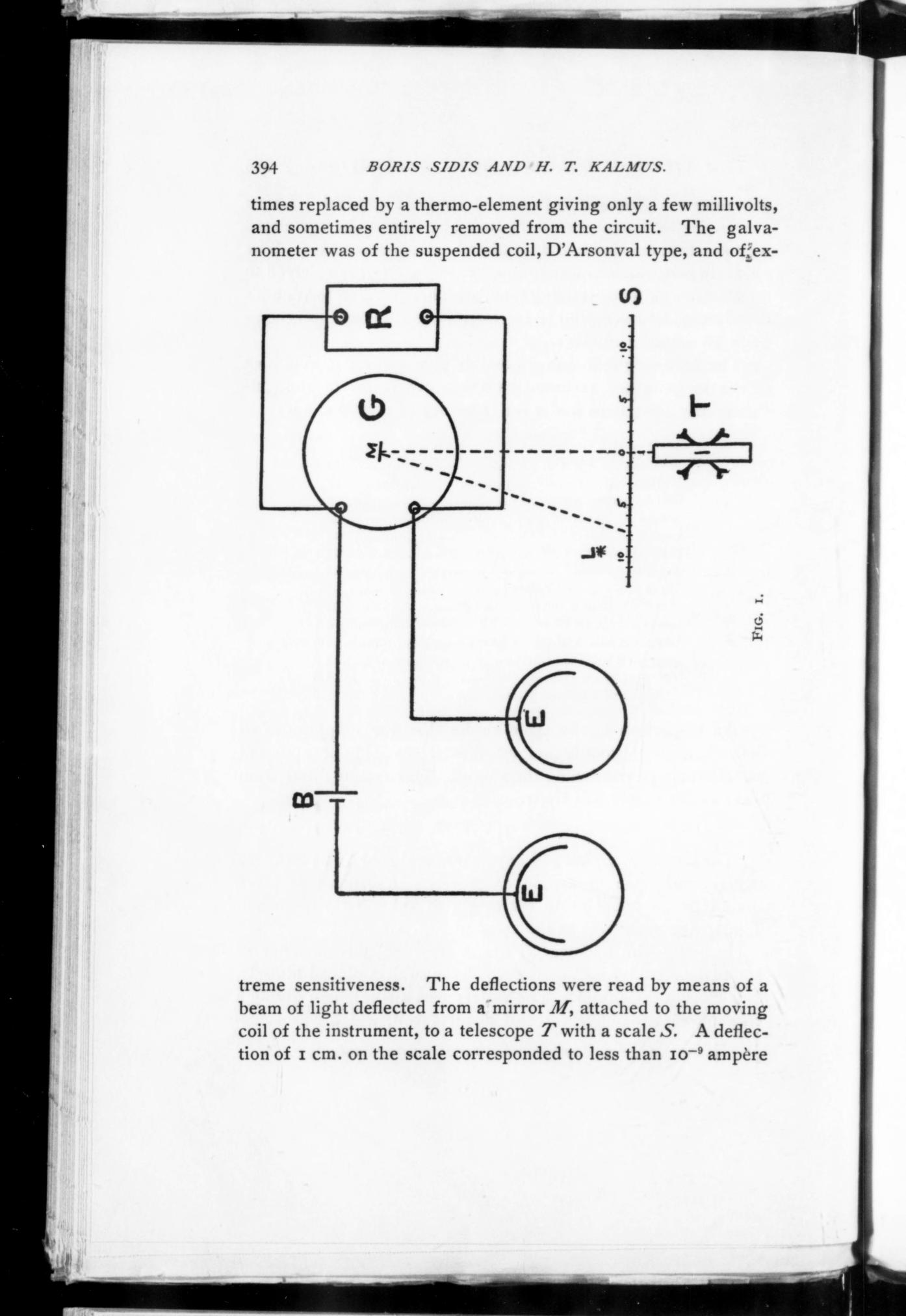
Diagram by Sidis and Kalmus, 1908
The first printed diagram. Sidis and Kalmus, Psychological Review, 1908, p. 394. It is the same loop: battery B (about 1 volt), electrodes E, galvanometer G with resistor R in parallel.

Jung adds a practical idea: a slider that the operator pushes by hand to follow the spot of light, linked to a pen that writes on a roll of paper. He reads a word, waits, watches. The reaction starts one to six seconds after the word. Nobody speaks of resistance in ohms: they count millimetres.

The first figures in ohms come in 1911, from Wells and Forbes, still with the simple loop: a 0.67 volt cell, about 100 microamperes through the body, resistances between 5,000 and 35,000 ohms. Keep these numbers in mind.

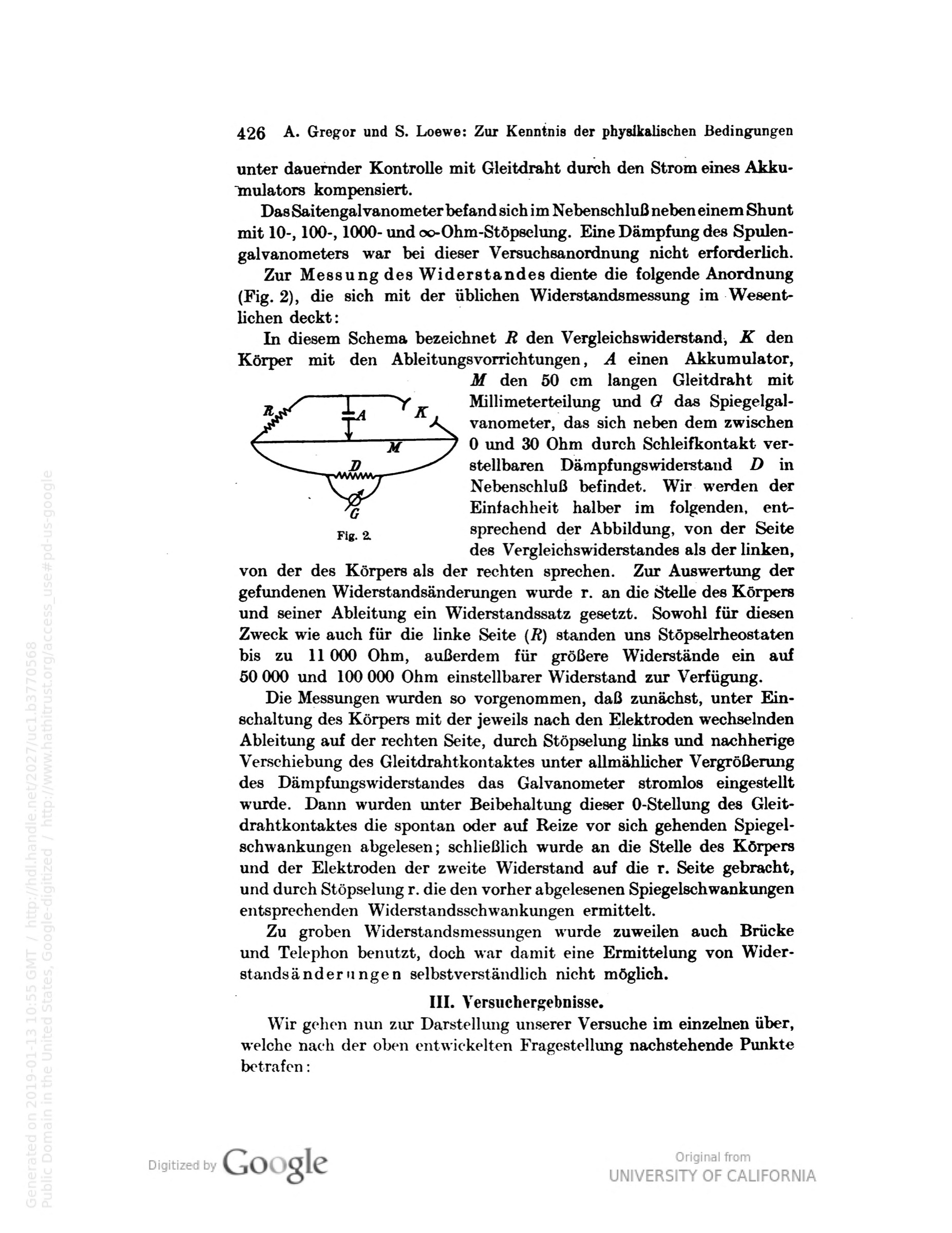
1912: the bridge

Gregor and Loewe want to measure the resistance, not just watch it change. They take the circuit used in the laboratory to measure any resistance: the bridge. The body becomes one of the four arms; opposite it goes a known resistance; a slider runs along a wire until no more current flows through the galvanometer. At that point the bridge is balanced, and the position of the slider tells what the body is worth.

1912accumulatorvoltage not givencomparison resistanceup to 11,000 Ωwire, section aslider on 50 cmbodywith the electrodeswire, section bslider on 50 cmgalvanometer
Gregor and Loewe, 1912: the slide-wire bridge. One nulls it with the slider, leaves it there and reads the deflections; then a resistance box in place of the body translates them into ohms.
Figure 2 of Gregor and Loewe, 1912
The original. Zeitschrift für die gesamte Neurologie und Psychiatrie 12, 1912, p. 426: R comparison resistance, K body, A accumulator, M 50 cm wire, G galvanometer.

From here on the galvanometer does two jobs. Still at zero, it says that the bridge is balanced and therefore what the resistance is. When it moves, it shows the reaction.

1922: the bridge enters the psychology books

Whately Smith, at Cambridge, publishes The Measurement of Emotion with the complete diagram: a 2 volt cell, two fixed resistors, a resistance box with dials. He balances once at the start and then leaves it alone: he only reads how far the spot of light moves. Three years later David Wechsler publishes a similar circuit, which a Chicago firm puts on sale at 1.5 volts.

1922cell2 Vfixed1,000 Ωfixed100 Ωbodyzinc electrodesdecade boxadjusted at the startgalvanometer
Whately Smith, 1922, p. 33. The decade box is the arm that is adjusted; the values of the fixed resistors are those printed on the figure.

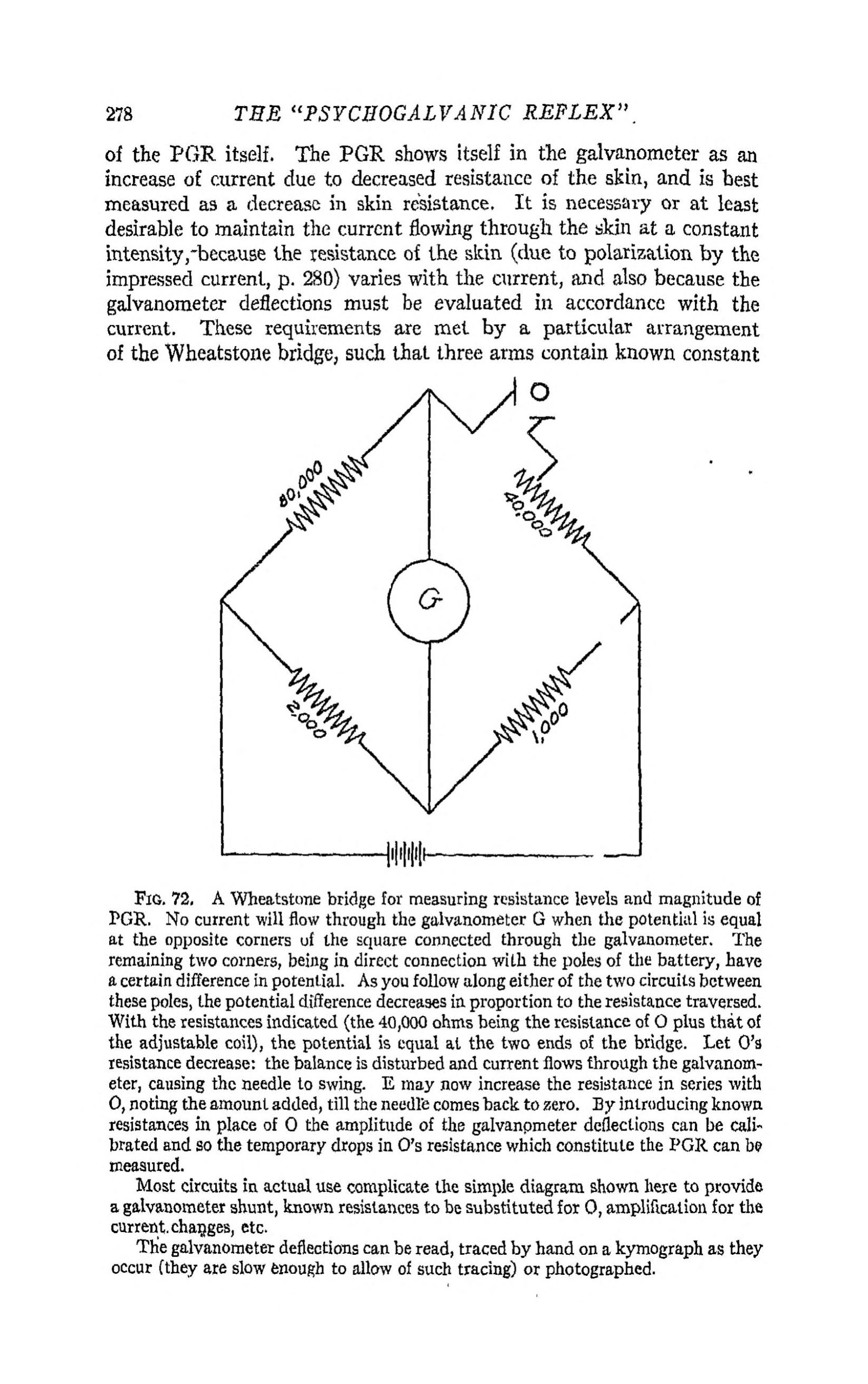
1928–1938: the calibrated resistance that brings the needle back to zero

Here is born the gesture that anyone who has used an E-meter knows well. Jeffress, in 1928, puts a resistance box in series with the subject: when the body’s resistance drops, he adds as much again and the needle returns to zero. What he has added is the measurement. Ten years later Woodworth’s textbook, from which generations of American psychologists learned, presents it as the normal circuit:

“Let O’s resistance decrease: the balance is disturbed and current flows through the galvanometer, causing the needle to swing. E may now increase the resistance in series with O, noting the amount added, till the needle comes back to zero.”

— Woodworth, Experimental Psychology, 1938, p. 278.

1938cellvoltage not givenfixed80,000 Ωfixed2,000 Ωbodycalibrated coilfixed1,000 Ωgalvanometer
Woodworth, 1938, figure 72. The body arm is worth 40,000 ohms in all: the body plus the calibrated coil. Two separate readings: the coil gives the level, the needle gives the reaction.
Figure 72 of Woodworth, 1938
The original. The Wheatstone bridge for measuring resistance levels and the size of the psychogalvanic reflex.

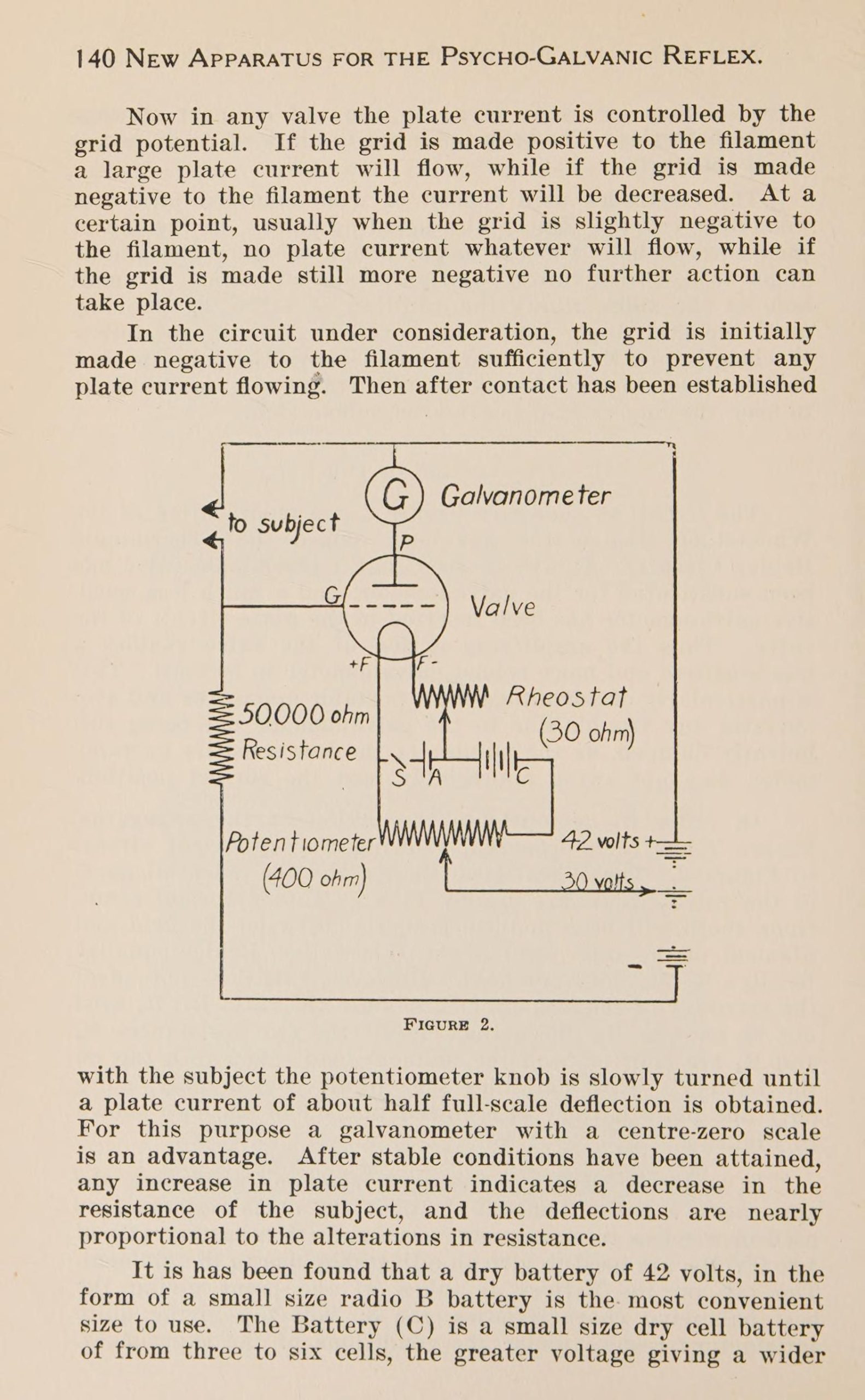
1928: a valve in place of the galvanometer

The mirror galvanometer is delicate, expensive and needs a dark room. In Sydney, Bellingham, Langford Smith and Martin replace it with a radio valve and a panel needle instrument. They call it the “thermionic bridge”. One turns a potentiometer until the needle sits at mid-scale, then watches:

“…any increase in plate current indicates a decrease in the resistance of the subject, and the deflections are nearly proportional to the alterations in resistance.”

— Australasian Journal of Psychology and Philosophy 6, 1928, p. 140.

1928battery30 Vpotentiometer400 Ω: sets the zerofixedbodyfixed50,000 Ωvalvecentre-zero instrument
The “thermionic bridge” of 1928, in the equivalent bridge form given by the authors themselves. The instrument has its zero at the centre and reaches full scale with about 10 microamperes.
Figure 2 of Bellingham and others, 1928
The original. The subject, the 50,000 ohm resistor, the valve, the galvanometer on the plate, the 400 ohm potentiometer.

With this all the parts are there: bridge, body on one arm, knob that brings it back to zero, amplifier, panel needle. The year is 1928.

1930: someone points out the flaw

The bridge has a problem, and the psychologists see it at once. The same change in resistance moves the needle more or less depending on the level one is at. R. C. Davis writes it in 1930:

“The most common circuit used for study of the galvanic reaction is the wheatstone bridge… But as it is ordinarily used the electrical relations become extremely complicated, and direct proportionality of deflection to resistance change is lost.”

— Davis, Archives of Psychology 115, 1930, p. 12.

Davis and others respond with constant-current circuits. The bridge, however, remains the standard, flaw and all. Remember it: it comes back at the end.

1951: Mathison

Volney Mathison files his “electropsychometer” on 1 August 1951. In the first line of the patent he states where he starts from:

“It has been known for many years that if a subject is connected in series with a sensitive galvanometer and a source of low-potential direct current […] the psychogalvanometric arrangement as a whole is a valuable adjuvant in psychoanalysis and psychotherapy.”

— US patent 2,684,670.

1951plate batteryabout 250 Vfixedfixedbodymetal spongestone lever50 kΩ, numbered scale2 triodes50 µA microammeter
Mathison’s electropsychometer, much simplified: in the patent the bridge is formed by the two triodes. The novelty is the lever on a numbered scale, which according to the text shows the patient’s tone level.

It is the 1928 circuit inside a box, with a new name on the knob. The electrodes are sponges of metal fabric; the cans arrive shortly afterwards, at someone else’s suggestion.

1966: the Hubbard patent

The patent is titled Device for measuring and indicating changes in resistance of a living body. The valves become three transistors, the supply two batteries, and the knob receives a calibration in ohms: 5,000 ohms at position 2, 12,500 at position 3.

1966batteries1.5 V and 6 Vfixed22 kΩfixed6.8 kΩbodycans in the handstone arm5 kΩ = 2 · 12.5 kΩ = 33 transistors100 µA instrument
US patent 3,290,589, simplified. Compared with 1951 the amplifier and the calibration of the tone arm change. The needle has a rest point one third of the way along the scale.

Hubbard himself, in the 1952 manual, does not claim the measurement:

“The measurement of thought with a meter is not new; the understanding and accuracy of measurement is new.”

— Electropsychometric Auditing, 1952.

1996: the flaw of 1930, solved

Davis’s problem remains: with a low tone arm the same reaction makes a big needle movement, with a high tone arm a small one, and the operator has to touch up the sensitivity by hand. US patent 6,011,992, filed in 1996, closes it with a circuit that reads the position of the tone arm and adjusts the gain by itself. The claim says:

“…adjusting the gain of said amplifier circuit according to a predetermined ratio such that a generally constant amplitude response is generated for a measured change in resistance.”

— US patent 6,011,992.

1996cellfixedfixedbodycans in the handstone arm5 kΩ = 2 · 12.5 kΩ = 3amplifierinstrument
US patent 6,011,992. The dashed arrow is the novelty: the tone arm controls the gain of the amplifier. Sixty-six years after Davis’s objection.

How each part changes

Body
nickel cylinders in the hands (1907)→plates, salt-water baths→zinc electrodes (1922)→metal sponges (1951)→cans
Source
2.4 V (1907)→0.67 V (1911)→2 V (1922)→1.5 V (1925)→1.5 and 6 V batteries (1966)
Indicator
spot of light on a scale→centre-zero needle (1928)→50 µA microammeter (1951)→100 µA with rest point (1966)
Balance
none (1907)→slider on a wire (1912)→decade box (1922)→calibrated coil in series (1928–38)→tone lever (1951)→tone arm in ohms (1966)
Sensitivity
shunt (1907)→valve (1928)→two triodes (1951)→three transistors (1966)→automatic gain (1996)

The same thing

Line up the figures stated by the authors, and this is the picture.

YearWhoVoltageCurrent through the bodyResistance read
1907Veraguth2.4 Vnot givenmillimetres only
1911Wells and Forbes0.67 V95–114 µA5,000–35,000 Ω
1922Whately Smith2 Vnot givenmillimetres only
1925Wechsler, commercial version1.5 Vnot givenread on the bridge
1936Ruckmick’s review—40–100 µA—
1966Hubbard patent1.5 and 6 Vnot given5,000 Ω = 2 · 12,500 Ω = 3
2004patent of the digital model—no more than 50 µAin ohms, computed

One or two cells. A few tens of microamperes from one hand to the other. A skin that is worth between five thousand and a few tens of thousands of ohms, and that for a couple of seconds is worth a little less when something happens to the person. Jung watched it as a spot of light sliding along a celluloid scale; someone using an E-meter watches it as a needle that falls. It is the same physical quantity, measured in the same way, with the same order of current.

What ninety years have added is ease of reading: a way to get back to zero, a number for the level, a sturdy needle in place of a mirror, and in the end a circuit that keeps the amplitude constant.

What is certain and what is not

Read from the original figures and texts: the diagrams of 1908, 1912, 1922, 1928 and 1938; the voltages of Veraguth, Wells and Forbes, Whately Smith; the values in the two patents; all the quotations.

Reconstructed or simplified: the 1907 diagram (Veraguth and Jung describe it only in words); the diagrams of 1951, 1966 and 1996, reduced to the bridge form so that they can be compared.

Second-hand: the voltage of the commercial Wechsler instrument and Ruckmick’s currents come from reviews of 1935–36, not from the original articles.

Not found: a printed diagram by Waller, who nevertheless used the bridge from 1918; Wechsler’s original 1925 article (the figure is known from a 1933 reproduction).

Sources

Veraguth, Monatsschrift für Psychiatrie und Neurologie 21, 1907 · Jung, Journal of Abnormal Psychology 1, 1907 · Peterson and Jung, Brain 30, 1907 · Sidis and Kalmus, Psychological Review 15, 1908 · Wells and Forbes, Archives of Psychology 16, 1911 · Gregor and Loewe, Zeitschrift für die gesamte Neurologie und Psychiatrie 12, 1912 · Whately Smith, The Measurement of Emotion, 1922 · Jeffress, Journal of Experimental Psychology 11, 1928 · Bellingham, Langford Smith and Martin, Australasian Journal of Psychology and Philosophy 6, 1928 · Davis, Archives of Psychology 115, 1930 · Ruckmick, The Psychology of Feeling and Emotion, 1936 · Woodworth, Experimental Psychology, 1938 · US patents 2,684,670 (Mathison), 3,290,589 (Hubbard), 6,011,992.

Is remote auditing impossible? What the Basic Auditing Series says

Italiano · English

Basic auditing · Reading the texts

I reread the eleven bulletins looking for a passage that makes the communication cycle impossible when auditor and pc are not in the same room. There isn’t one. What the text does contain is a set of precise requirements the link has to meet.

Reference: Basic Auditing Series 1R–11, HCO Bulletins of 23 May 1971

In brief

Nowhere in the eleven bulletins is it required that the two bodies share the same place. The passages that touch on the matter say the opposite: distance is part of the formula, and the medium is declared irrelevant.

What the bulletins do require is perception: seeing the pc, reading the meter, acknowledging at the right instant. A link that does not carry those things does not satisfy the text. A phone call, for one, contradicts it explicitly.

The question

The objection comes up often: auditing only works in person, because there has to be “something” between auditor and pc that a screen cannot carry. That is a claim about the tech, so it can be checked against the tech.

The Basic Auditing Series is the right place to look. It is eleven bulletins, reissued together on 23 May 1971, on a single subject: the communication cycle between auditor and pc, which the first bulletin calls “about the only thing that makes auditing work”. If physical presence were a condition, this is where it would be written. Below I cite them as BAS (Basic Auditing Series) followed by the number: BAS 4R is the fourth bulletin of the series, revised.

I read them looking for every sentence that mentions place, distance, sight, touch, gesture or instrument, and asked of each one: does this sentence stay true if the two people are in different cities?

Four passages that rule out impossibility

  1. They are cause, distance, effect with the Auditor at cause and the Pc at effect, and cause, distance, effect with the Pc at cause and the Auditor at effect.

    BAS 4R, Communication Cycles Within the Auditing Cycle

    The cycle is defined as cause, distance, effect. Distance is a term of the formula, and the bulletin gives it neither a measure nor a limit. One metre and a thousand kilometres are both “distance”.

  2. Even if it’s telepathy it’s cause, distance, effect. It doesn’t matter how that communication took place, you know whether he’s answered the command by a communication cycle. I don’t care how you sense this.

    BAS 4R

    The medium is declared irrelevant, provided the cycle completes. It is the plainest statement on the subject in the whole series.

  3. Actually there is no backflow of any kind that hits the auditor […] It isn’t burning the mass, it is as-ising the mass and that’s why there is nothing hitting the auditor.

    BAS 1R, The Magic of the Communication Cycle

    The first bulletin describes auditor and pc as two poles, and the image could be read electrically: two poles close together, a current between them. The text rules that out at once. Nothing physical passes between the two bodies; the pc’s mass is as-ised, not transferred. A model in which nothing travels from one body to the other does not need the bodies to be near each other.

  4. This cut communication line is not perceivable to the naked eye. It’s hidden because it’s from the Pc—a Thetan unseen by the Auditor—to the Pc’s bank—unseen by the Auditor.

    BAS 3, The Three Important Communication Lines

    Of the three lines in a session, the most important is the one from the pc to his bank. The bulletin says the auditor cannot see it with the naked eye even when the pc is sitting in front of him. The decisive part of the session does not depend on anything the two bodies have in common.

What the text actually requires

The absence of a prohibition does not mean any link will do. The bulletins ask the auditor to perceive a good many things, and each of them becomes a condition on the channel. The first is the hardest.

Seeing the pc

An Auditor who isn’t watching a Pc at all never notices a Pc who isn’t receiving or understanding the auditing command.

BAS 4R

Of the six communication cycles that make up one auditing cycle, at least three rest on observation: is the pc ready to receive the command? Did he receive and understand it? Did he receive the acknowledgement? The bulletin says you can tell “by looking at the Pc”. Audio alone contradicts the text. With video the condition holds.

Seeing hands and cans

…this handles such a thing as the Pc originates by throwing down the cans. That’s still an origin.

BAS 4R

An origination need not be in words. If the camera frames only the face, the auditor misses it.

Reading the meter in real time

In the absence of that communication you do not get meter action.

BAS 1R; BAS 2R asks for “perfect meter reading”

The meter is on the pc’s side, the auditor on the other. The bulletins do not say where the instrument has to be; they say the auditor has to read it. Without a remote view of needle and tone arm, metered actions cannot be done as described.

Read and thought in sync

Steering a pc with “That—That—That” on something reading is allowable.

BAS 11, Metering

Steering works if the “that” reaches the pc while he is still looking at the thing that made the meter read. Here the delay adds up twice: the read travels to the auditor, the voice travels back to the pc. If the total is too long, the auditor is pointing at something other than what read.

Acknowledgement at the right instant

He looks like he’s finished and he feels like he’s finished. It’s part sense; it’s part his vocal intonation.

BAS 5R; see also BAS 4R and BAS 7, Premature Acknowledgements

An acknowledgement given before the pc has finished chops his communication; one that arrives late leaves him talking into nothing. These are the two errors the series spends the most pages on. A link with delay, or with audio that lets only one voice through at a time, produces both by itself, even for an auditor with flawless TRs.

Eye contact as an indicator

Pcs who won’t look at you are ARC Broken.

BAS 9, Comm Cycle Additives

On video, someone looking at the other person’s face on the screen is not looking into the lens. A pc who is looking at you can appear to be looking elsewhere. The indicator has to be recalibrated, or it gives false alarms.

Hearing clearly

The ONLY time you ever ask for a repeat is when you couldn’t hear it.

BAS 9; the correct wording is in BAS 6, Auditor Failure to Understand

Asking for a repeat because you did not hear is allowed, and BAS 4R says every flub adds communication cycles to the auditing cycle without breaking it. Poor audio therefore does not prevent a session, but it weighs it down with every “I did not hear you”.

Something both can see

Just get the pc to say it again or get the pc to point it out again.

BAS 6

For the pc to point something out, an item on a list for instance, that something has to be visible to both. A shared list or screen is needed.

Where distance removes a possible error

Also, do not shove things at a pc or throw things to a pc. Don’t gesture toward a pc. It drives in anchor points and makes the pc reject the auditor.

BAS 6 forbids shoving or throwing things at the pc. These are the only passages in the series that presuppose a shared physical space, and they are prohibitions: at a distance those errors cannot be committed. Gesturing toward the pc, on the other hand, is still possible on video and still forbidden.

What this reading does not cover

  • “Auditor presence”. BAS 2R lists auditor presence among the things that have to be perfect, but the series does not define it. If it is defined elsewhere as the presence of the body, the conclusion changes.
  • The reality of the terminal. BAS 1R says the pc needs a second terminal because he considers himself mass, and BAS 2R says a communication line depends on reality, communication and affinity. Whether an auditor on a screen is a real enough terminal for a given pc is settled pc by pc, not from the texts.
  • This is a reading, not a proof. I am saying the bulletins do not rule it out. Whether a remote session gets the same results as one in person is something only results can show.

In practice

Anyone who wants to run a remote session while staying inside these bulletins has a checklist already written:

  • video always, never voice alone;
  • a frame that takes in face, hands and cans;
  • needle and tone arm visible to the auditor in real time;
  • two-way simultaneous audio, with no cut-outs when voices overlap;
  • delay low enough not to distort acknowledgements and steering: test it beforehand, not in session;
  • remember that the pc’s gaze on video is misleading.

If one of these is missing, it is not distance that breaks the communication cycle. It is the channel failing to carry what the text asks the auditor to perceive.

Sources. Basic Auditing Series 1R, 2R, 3, 4R, 5R, 6, 7, 8, 9, 10R, 11: HCO Bulletins of 23 May 1971 (Issues I–X), some revised between November and December 1974. BAS 6 reissues the HCOB of 17 October 1962, BAS 7 that of 7 April 1965, BAS 8 that of 5 February 1966, BAS 9 the HCO PL of 1 July 1965.

Quotations are from the original text.

Il «Procedimento Preoccupazione» è tradotto male

Correzione di traduzione · Grado 2

Nell’edizione italiana dei fogli dei gradi il Worry Process è stato reso con «preoccupare». In quel bollettino worry vuol dire tormentare. Ogni auditor che ha i gradi in italiano ha in mano i comandi sbagliati.

Riferimento: HCOB 22 dicembre 1960, O-W A Limited Theory

In breve

Nei fogli italiani del Grado 2 c’è un procedimento intitolato Procedimento Preoccupazione. Il titolo e i tre comandi sono una traduzione errata dell’originale inglese: non è una svista di una copia, è nel testo dell’edizione italiana, quindi in tutte le copie.

Chi audisce il Grado 2 in italiano deve correggere a mano la propria copia prima di usare il procedimento. I comandi corretti sono qui sotto.

Com’è nei fogli italiani

Procedimento Preoccupazione

  1. «Abbi l’idea di preoccupare qualcosa.»
  2. «Abbi l’idea di non preoccupare qualcosa.»
  3. «Abbi l’idea di qualcosa che sia preoccupato.»

Come va corretto

Procedimento Tormento

  1. «Abbi l’idea di tormentare qualcosa.»
  2. «Abbi l’idea di non tormentare qualcosa.»
  3. «Abbi l’idea che qualcosa sia tormentoso.»

Di quale procedimento si parla

In inglese è il Worry Process, procedimento numero 7 nell’elenco dei procedimenti del Grado 2 dato dal BTB del 15 novembre 1976, Issue IV, 0-IV Expanded Grade Processes – Quads, Part D, Grade 2 Processes (che annulla il BTB del 4 gennaio 1972RB, la versione a tre flussi). In altre edizioni dei gradi il numero d’ordine può essere diverso: fa fede il nome.

Il riferimento che il BTB indica è il bollettino HCO del 22 dicembre 1960, O-W A Limited Theory, scritto a Johannesburg e ristampato da Saint Hill il 5 gennaio 1961. Nel bollettino i comandi sono tre:

Get the idea of worrying something.
Get the idea of not worrying something.
Get the idea of something being worrisome.

Il bollettino aggiunge che al posto di something si possono usare persone, animali o cose.

Dove sbaglia la traduzione italiana

Gli errori sono due, e il secondo discende dal primo.

Il verbo. Davanti a worry la mano va da sola su «preoccupare» e «preoccuparsi». È il senso che la parola ha quasi sempre nell’inglese di tutti i giorni: I worry about my son, sono in pensiero per mio figlio. Ma nei comandi il verbo ha un complemento oggetto diretto: worrying something, non worrying about something. Con l’oggetto diretto worry ha un altro significato, più antico e più fisico.

Senso sbagliato qui

to worry about — essere in pensiero, stare in ansia per qualcosa.

È uno stato d’animo. Nessuno lo subisce tranne chi lo prova.

Senso giusto qui

to worry (qualcosa, qualcuno) — tormentare, assillare, non lasciare in pace.

È un’azione. C’è qualcuno o qualcosa che la riceve.

L’esempio classico dei dizionari inglesi è the dog worries a bone: il cane che tiene l’osso fra i denti, lo scuote, lo mordicchia e non lo molla. La parola viene dall’inglese antico wyrgan, «strangolare»; il senso di «essere in ansia» è arrivato molti secoli dopo. Un bambino che tira la gonna della madre finché lei non cede la sta worrying. Così chi stuzzica una crosta, chi punzecchia un collega, chi non smette di fare domande.

«Abbi l’idea di preoccupare qualcosa», poi, in italiano non sta in piedi: una cosa non si può preoccupare. Il pc, per dare un senso al comando, lo aggiusta da sé in «preoccuparsi di qualcosa», e finisce ancora più lontano dall’originale.

Il terzo comando. Something being worrisome è qualcosa che dà tormento. I fogli italiani dicono «qualcosa che sia preoccupato», cioè qualcosa che il tormento lo prova. La direzione è rovesciata: in inglese worrisome non vuol mai dire «preoccupato» (che è worried).

Le prove sono nel bollettino

Non serve fidarsi del dizionario. Il testo stesso dice in cinque punti quale dei due sensi intende.

  1. Worrying others / Worrying about others

    Sono due gradini distinti e consecutivi del ciclo discendente. Se worry volesse dire «preoccuparsi», sarebbero lo stesso gradino scritto due volte. Il primo è tormentare gli altri, il secondo è preoccuparsi per gli altri.

  2. Worrying something is close to the lowest level of overt.

    «Tormentare qualcosa è vicino al livello più basso di overt.» Un overt è un atto commesso contro qualcosa. Stare in ansia non è un atto contro nessuno.

  3. It is the lowest effort to individuate.

    «È lo sforzo più basso per individuarsi.» Ci si stacca dall’altro dandogli fastidio. Preoccupandosi per lui si fa il contrario.

  4. Many pcs use their processing just to worry the auditor.

    «Molti pc usano il proprio processing solo per tormentare l’auditor.» Qui la lettura «preoccupare» non regge nemmeno per un momento, e ogni auditor ha in mente il pc di cui si parla.

  5. Worrying people is almost a way of life for the juvenile […] stuck in the violent motion of childhood and worrying others.

    «Tormentare la gente è quasi un modo di vivere per chi è immaturo.» Il ragazzino che non dà tregua, non il ragazzino ansioso.

Ecco il ciclo com’è nel bollettino, con i due gradini messi a confronto:

  • Independent beingsEsseri indipendenti
  • CommunicationComunicazione
  • Mis-communicationComunicazione sbagliata
  • ControlControllo
  • Mis-controlControllo sbagliato
  • HelpAiuto
  • Failed helpAiuto fallito
  • Overts and withholdsOvert e withhold
  • Overts and withholds by transferOvert e withhold per trasferimento
  • Worrying othersTormentare gli altri
  • Worrying about othersPreoccuparsi per gli altri
  • Being criticalEssere critici
  • Being critical of selfEssere critici verso sé stessi

Il procedimento lavora sul primo dei due gradini evidenziati. Il bollettino dice che il worry «sta sotto» l’O-W (undercuts O-W): raggiunge i casi che non sono ancora in grado di riconoscere i propri overt, ma che riescono a riconoscere di aver tormentato qualcuno o di essere stati tormentati.

Perché la differenza conta in seduta

Con i comandi dei fogli italiani il preclear va a cercare le proprie ansie: il mutuo, la salute, il figlio che torna tardi. Guarda ciò che gli pesa addosso. È il gradino sotto.

Con i comandi giusti guarda ciò che lui fa agli altri e alle cose: stuzzicare, punzecchiare, insistere, non mollare. È un overt, del tipo più leggero, ed è per questo che il procedimento sta sul Grado 2 insieme agli altri procedimenti di O-W. Tradotto con «preoccupare», perde proprio la parte per cui è stato messo lì.

Il chiarimento dei comandi non salva la situazione. Un pc italiano a cui si chiarisce «preoccupare» capisce benissimo la parola e la capisce nel senso sbagliato, senza che niente lo segnali: nessuna parola malcompresa da trovare, perché l’errore è a monte, nella traduzione.

I comandi corretti, flusso per flusso

Il BTB del 15 novembre 1976, Issue IV, riporta il procedimento su quattro flussi. I comandi del flusso 2 sono quelli del bollettino del 1960; gli altri tre flussi sono la stesura del BTB, che avverte di non sostituire i materiali originali. Qui sotto ogni comando italiano ha sotto l’originale.

Flusso 1

«Abbi l’idea di un altro che tormenta qualcosa.»Get the idea of another worrying something.

«Abbi l’idea di un altro che non tormenta qualcosa.»Get the idea of another not worrying something.

«Abbi l’idea che qualcosa sia tormentoso per un altro.»Get the idea of something being worrisome to another.

Flusso 2 — i comandi del bollettino

«Abbi l’idea di tormentare qualcosa.»Get the idea of worrying something.

«Abbi l’idea di non tormentare qualcosa.»Get the idea of not worrying something.

«Abbi l’idea che qualcosa sia tormentoso.»Get the idea of something being worrisome.

Flusso 3

«Abbi l’idea di altri che tormentano qualcosa.»Get the idea of others worrying something.

«Abbi l’idea di altri che non tormentano qualcosa.»Get the idea of others not worrying something.

«Abbi l’idea che qualcosa sia tormentoso per altri.»Get the idea of something being worrisome to others.

Flusso 0

«Abbi l’idea di tormentarti per qualcosa.»Get the idea of worrying yourself about something.

«Abbi l’idea di non tormentarti per qualcosa.»Get the idea of not worrying yourself about something.

«Abbi l’idea che qualcosa sia tormentoso per te.»Get the idea of something being worrisome to yourself.

Con persone, animali o cose al posto di «qualcosa»: «Abbi l’idea di tormentare tua sorella», «…il gatto», «…il motore della macchina».

La seconda parte: l’attaccare

Il bollettino avverte che il procedimento, percorso a lungo da solo, si impantana, e che va tenuto in movimento con un secondo procedimento sull’attaccare. Per il bollettino è dunque un altro procedimento (another process), da percorrere insieme al primo. Il BTB non gli dà né titolo né numero: lo mette sotto lo stesso numero 7, dopo la dicitura also run, «percorri anche». Per questo nei fogli italiani compare come seconda parte del Procedimento Preoccupazione, con i suoi flussi: «Abbi l’idea di qualcosa che ti attacca», «Abbi l’idea di qualcosa che non ti attacca», e così via.

Qui il verbo è reso bene, «attaccare» è attack, e la seconda parte si può continuare a usare. La riportiamo per intero dal BTB, così chi corregge la propria copia ha tutto il procedimento sotto gli occhi.

Flusso 1

«Abbi l’idea di un altro che ti attacca.»Get the idea of another attacking you.

«Abbi l’idea di un altro che non ti attacca.»Get the idea of another not attacking you.

Flusso 2

«Abbi l’idea di attaccare.»Get the idea of attacking.

«Abbi l’idea di non attaccare.»Get the idea of not attacking.

Flusso 3

«Abbi l’idea di altri che attaccano qualcosa.»Get the idea of others attacking something.

«Abbi l’idea di altri che non attaccano qualcosa.»Get the idea of others not attacking something.

Flusso 0

«Abbi l’idea di te che attacchi te stesso.»Get the idea of you attacking yourself.

«Abbi l’idea di te che non attacchi te stesso.»Get the idea of you not attacking yourself.

Nel bollettino del 1960 la coppia è data in forma generale: Get the idea of attacking something / Get the idea of not attacking something, «Abbi l’idea di attaccare qualcosa», «Abbi l’idea di non attaccare qualcosa».

Note sulla resa

  • Perché «tormentare» e non «infastidire» o «assillare». Tutti e tre rendono il senso. «Tormentare» è l’unico che regge anche il terzo comando («tormentoso») e il flusso 0 («tormentarsi per»), così i comandi restano sulla stessa radice, come in inglese restano tutti su worry.
  • Il titolo. «Procedimento Tormento» ricalca la forma del titolo italiano attuale cambiando solo la parola sbagliata. Chi annota la propria copia può anche lasciare accanto il titolo inglese, Worry Process.
  • Il terzo comando. Worrisome da solo si potrebbe rendere con «preoccupante». Ma cambiare radice al terzo comando spezza il procedimento: il pc deve guardare la stessa cosa da due lati, lui che tormenta e qualcosa che tormenta.
  • Il flusso 0. È l’unico punto in cui l’inglese usa worry about. Qui «tormentarsi per qualcosa» copre anche il senso di rodersi, stare in pensiero, senza abbandonare il verbo.
  • «Get the idea of». «Abbi l’idea di», come già nei fogli italiani. Questa parte della traduzione è giusta e non va toccata.

Cosa fare

  • Correggete la vostra copia. Nei fogli italiani del Grado 2, al Procedimento Preoccupazione, sostituite titolo e comandi della prima parte con quelli riportati qui, su tutti i flussi. La seconda parte, sull’attaccare, resta.
  • Avvisate il C/S. Se il procedimento è già stato percorso su un pc con i comandi italiani, segnalatelo: quel pc ha percorso un altro procedimento, e la decisione su cosa fare spetta a chi supervisiona il caso.
  • Avvisate chi cura la traduzione. La correzione va fatta nell’edizione italiana, non solo nelle copie di chi ha letto questa nota.
  • Fate girare questa nota fra gli auditor e i supervisori del caso che lavorano in italiano.

Fonte. HCO Bulletin of 22 December 1960, O-W A Limited Theory, distribuzione Franchise; ristampato da Saint Hill Manor il 5 gennaio 1961. Nei vecchi volumi tecnici: vol. IV, pp. 186–187. I comandi per flusso sono quelli del Board Technical Bulletin del 15 novembre 1976, Issue IV, 0-IV Expanded Grade Processes – Quads, Part D, Grade 2 Processes (annulla il BTB del 4 gennaio 1972RB, 0-IV Expanded Grade Processes – Triples, Part D, Grade 2 Processes), procedimento 7, Worry Process.

Le citazioni in inglese sono riportate dal bollettino e dal BTB. Il testo italiano errato è quello dei fogli dei gradi in lingua italiana, alla voce «Procedimento Preoccupazione». Le traduzioni corrette sono di chi scrive.

La Linea Invisibile tra il PC e il suo Bank

Quando si osserva una seduta di auditing dall’esterno, si vedono due persone sedute una di fronte all’altra. Una parla, l’altra ascolta e occasionalmente fa domande. Sembra semplice. Eppure, in quello spazio apparentemente vuoto tra auditor e preclear, vi è una linea invisibile che determina se quella seduta produrrà risultati straordinari o sarà solo una perdita di tempo.

Il triangolo invisibile

La maggior parte delle persone pensa che l’auditing sia una conversazione tra auditor e preclear. Questa è l’illusione più pericolosa in cui un auditor possa cadere. In realtà, esistono tre linee di comunicazione simultanee, e quella più importante è completamente invisibile:

La prima linea – quella che conta davvero – collega il preclear al suo bank. È qui che avviene la vera magia: il pc guarda dentro di sé, osserva la propria mente reattiva, confronta la carica. Questa è la linea produttrice di Itsa.

La seconda linea va dal pc all’auditor. È il semplice rapporto di ciò che sta accadendo sulla prima linea. “È questo. È quello.” Niente di più. Questa è la linea dell’Itsa.

La terza linea va dall’auditor al pc. Sono le domande, le istruzioni, le indicazioni che guidano l’attenzione del preclear verso il suo bank. Questa è la linea del “cos’è”.

L’errore fatale

Immagina un bambino che gioca in giardino, completamente assorto nell’osservare una formica che trasporta una briciola. Ogni pochi secondi, un adulto gli chiede: “Cosa stai guardando? Ti stai divertendo? Cosa vedi adesso? Hai bisogno di aiuto?” Il bambino, continuamente distratto, perde il contatto con quello che stava osservando. L’esperienza diretta viene sostituita da un tentativo di spiegare all’adulto cosa sta succedendo.

Questo è esattamente ciò che accade quando un auditor taglia la linea dell’Itsa. Fraintendendo il proprio ruolo, credendo che il suo compito sia far parlare il preclear a lui, l’auditor interrompe continuamente quella connessione invisibile ma vitale tra il pc e il suo bank.

Il risultato è immediato e inequivocabile: l’ago dell’E-meter diventa “sporco” – continuamente agitato. Non importa cosa sia successo nella seduta, quale procedimento si stia usando, quale livello si stia audendo. Un ago sporco significa sempre e soltanto una cosa: l’auditor ha interrotto la comunicazione del preclear con se stesso.

La danza tra azione e silenzio

Il momento in cui il preclear inizia veramente a guardare dentro di sé, a confrontare carica, a fare as-is di massa mentale, è un momento sacro che non va disturbato. È quando sta accadendo il vero lavoro della seduta.

Pensa all’auditing come a una danza con due movimenti:

  • Quando il pc sta guardando dentro = l’auditor tace e ascolta
  • Quando il pc ha finito di guardare = l’auditor agisce e guida

Solo l’auditor può bloccare quel prezioso processo di scarica. Il preclear non può farlo. Il bank non può farlo. L’unica cosa che può interrompere quel processo di dissoluzione della carica è un auditor che interviene al momento sbagliato.

Itsa: la semplicità fraintesa

“Itsa” è una parola che viene spesso equivocata. Non significa “lasciare parlare il pc a lungo”. Non significa “terapia verbale dove il cliente si sfoga”. Non significa nemmeno “esprimere emozioni”.

Itsa significa semplicemente: “È questo”.

Quando chiedi a un bambino “Cosa c’è in questa stanza?” e lui risponde “Il tavolo, la sedia, la finestra”, quello è Itsa. Sta identificando. Sta nominando. Sta dicendo cosa è presente.

Se invece risponde “Sono confuso, sono preoccupato, non so cosa fare”, quello NON è Itsa. Sta parlando di stati d’animo, di valutazioni, di reazioni – ma non sta dicendo di cosa si tratta realmente.

Nell’auditing, quando il preclear guarda il suo bank e dice “È la rabbia che provai quando mio padre…” – quello è Itsa. Sta identificando una massa specifica nella sua mente. Sta dicendo: “Questo è quello che vedo qui.”

Il paradosso del silenzio

Ecco il paradosso che confonde molti auditor: per aiutare il preclear a comunicare veramente, devi tacere.

La sequenza corretta è questa:

  1. L’auditor agisce: fa una domanda, dà un’istruzione, indica una direzione
  2. Il pc guarda dentro: si connette con il suo bank, osserva
  3. Il pc riporta: dice cosa ha visto, cosa ha trovato
  4. L’auditor riconosce: un semplice “Grazie” o “Bene”

Il problema nasce quando l’auditor non sa quando fermarsi. Fa la domanda, vede che il pc sta guardando dentro (lo si capisce dal suo sguardo, dalla sua attenzione rivolta verso l’interno) e poi… fa un’altra domanda. O chiede chiarimenti. O valuta. O interpreta.

L’auditor esperto, invece, quando vede che il pc sta guardando dentro di sé, si appoggia allo schienale della sedia e semplicemente aspetta. Il preclear, sentendo quello spazio silenzioso, distoglie l’attenzione dalla lista o dal procedimento e inizia a parlare. Ma non sta parlando all’auditor – sta riportando ciò che sta vedendo mentre guarda dentro di sé.

Questo può durare due minuti o un’ora. L’auditor fa solo piccoli cenni col capo e resta presente ma silenzioso. Solo quando quella scarica è completa – solo quando il preclear ha finito di guardare e identificare ciò che ha trovato – l’auditor si raddrizza e riprende a guidare.

La linea che non puoi vedere

La tragedia di molti auditor è che cercano di controllare ciò che possono vedere (il preclear seduto davanti a loro) e ignorano ciò che non possono vedere (la connessione tra il preclear e il suo bank).

Quella linea invisibile è dove avviene tutto. È lì che la carica si dissolve. È lì che le masse mentali scompaiono. È lì che accade il cambiamento reale.

L’auditor non produce il cambiamento. L’auditor crea le condizioni perché il cambiamento accada. Come un giardiniere non fa crescere le piante – crea le condizioni (acqua, luce, terreno) perché la pianta cresca da sola.

Un auditor che non comprende questa linea nascosta, che non sa come proteggerla e nutrirla, fallirà sempre. Non importa quanta tecnica conosca, quanti procedimenti sappia, quanto sia preciso nell’amministrazione. Se interrompe quella connessione invisibile, non otterrà risultati.

La disciplina del non-fare

La vera abilità di un auditor non sta nel fare molto, ma nel sapere quando non fare nulla.

Auditor cronicamente attivi – quelli che parlano, guidano, interpretano, chiariscono continuamente – avranno sempre preclear con aghi sporchi. Perché ogni loro intervento taglia quella linea fragile ma potente tra il pc e ciò che sta osservando dentro di sé.

L’auditor che ha veramente compreso questo principio sa che il suo ruolo è duplice:

  • Quando il pc non sta guardando dentro: guidare la sua attenzione, dargli qualcosa da osservare
  • Quando il pc sta guardando dentro: sparire, diventare invisibile, essere solo una presenza che ascolta

È un po’ come insegnare a qualcuno ad andare in bicicletta. All’inizio dai istruzioni e sostieni. Ma quando la persona inizia a pedalare da sola, devi lasciar andare. Se continui a dare istruzioni mentre pedala, la farai cadere.

Il segnale inconfondibile

Come fa un auditor a sapere quando sta interrompendo questa linea vitale? Il segnale è chiaro e inequivocabile: l’ago sporco.

Un ago continuamente agitato, indipendentemente da qualsiasi altra circostanza, significa sempre la stessa cosa: l’auditor ha tagliato la comunicazione del preclear. Ha interrotto quella connessione tra il pc e il suo bank.

Non serve cercare altre spiegazioni. Non serve fare procedimenti complessi. La soluzione è semplice: chiedere “Ho interrotto la tua comunicazione?” e poi imparare a non farlo più.

Gli auditor che tagliano cronicamente la comunicazione avranno sempre preclear con aghi sporchi. È una legge tanto certa quanto la gravità.

La ricompensa del rispetto

Quando un auditor rispetta veramente la linea dell’Itsa – quando protegge quella connessione invisibile tra il preclear e il suo bank – accadono cose straordinarie.

Il preclear cambia. Non superficialmente. Profondamente.

L’ago diventa pulito e resta pulito.

Il caso progredisce con una velocità che stupisce sia l’auditor che il preclear.

Le sedute diventano potenti, cariche di momenti in cui qualcosa di reale si dissolve, in cui masse mentali scompaiono, in cui la persona ritrova pezzi di se stessa che aveva dimenticato.

Tutto questo non perché l’auditor ha fatto qualcosa di speciale, ma perché ha saputo non fare al momento giusto. Ha rispettato quella linea invisibile. Ha permesso al preclear di confrontare veramente il proprio bank, senza interruzioni, senza interferenze.

La lezione essenziale

Se dovessi insegnare a un nuovo auditor una sola cosa – una singola lezione che fa la differenza tra successo e fallimento – sarebbe questa:

Il tuo compito non è far parlare il preclear a te. Il tuo compito è aiutare il preclear a guardare dentro di sé. E poi tacere mentre lo fa.

Quella linea invisibile tra il pc e il suo bank – quella che non puoi vedere, che non puoi misurare direttamente, che opera in uno spazio che sfugge ai tuoi occhi – è dove avviene tutta la magia dell’auditing.

Proteggila. Rispettala. Non interromperla.

E i risultati parleranno da soli.

Additivi

Esiste un principio fondamentale che attraversa tutta la filosofia di Scientology: ogni volta che aggiungiamo qualcosa a un essere, diminuiamo la sua capacità di affrontare la vita. Sembra controintuitivo, vero? Siamo abituati a pensare che più strumenti abbiamo, meglio è. Eppure Ron Hubbard ci ricorda che “l’uomo è un essere a cui è stato aggiunto qualcosa e tutto ciò che gli è stato aggiunto ha diminuito la sua capacità di affrontare le situazioni.”

La trappola delle soluzioni accumulate

Pensa a tutte le soluzioni che hai adottato nel corso della vita. Metodi per affrontare le persone difficili. Strategie per gestire lo stress. Regole su come comportarti in determinate situazioni. Molte di queste soluzioni erano perfettamente sensate quando le hai create, magari a cinque, dieci o vent’anni. Ma ora? Quante di queste risposte automatiche sono ancora valide oggi?

Il problema non è che tu abbia cercato di risolvere i problemi. Il problema è che quelle soluzioni si sono cristallizzate, sono diventate fisse, e ora le applichi anche quando non servono più. Hai risolto qualcosa che forse non aveva bisogno di essere risolto, o hai fissato una soluzione che doveva essere temporanea.

L’arte di far sparire ciò che non serve

In Scientology lavoriamo attraverso l’As-Isness: guardare le cose esattamente come sono. Non aggiungiamo nuove strategie, nuovi metodi, nuove tecniche. Facciamo il contrario. Permettiamo alla persona di osservare quelle vecchie soluzioni obsolete e di lasciarle andare.

Nell’auditing, quando una persona guarda un engram o una perdita finché non l’ha completamente compresa, quella carica scompare. Quando nello studio si chiarisce una parola malcompresa, la confusione si dissolve. Il pattern è sempre lo stesso: osservare con precisione ciò che è, e l’aberrazione svanisce.

La società degli additivi

Viviamo in una cultura che risponde a ogni problema aggiungendo qualcosa. Sei stanco? Prendi un integratore. Sei ansioso? C’è una pillola. Hai un problema relazionale? Ecco dieci strategie da applicare.

Raramente qualcuno ti dice: “Fermati. Guarda cosa sta succedendo davvero. Forse hai già troppe cose in corso.”

La nostra società grida costantemente: “Prendi! Compra! Devi!” E quando hai una difficoltà, vieni sommerso di consigli, di metodi, di soluzioni preconfezionate. Ciò che manca è qualcuno che semplicemente ascolti e capisca.

Il paradosso del corpo

Anche se il lavoro principale di Scientology riguarda il Thetan, l’essere spirituale, lo stesso principio si può osservare con il corpo. Pensiamo sempre che la risposta sia aggiungere qualcosa: un farmaco, un supplemento, un trattamento. Eppure spesso la soluzione vera sta nel rimuovere la causa.

Nella nostra società dell’abbondanza, il problema è raramente il troppo poco. È quasi sempre il troppo.

Riconoscere le giustezze

C’è un altro aspetto cruciale in tutto questo. Ron Hubbard sottolinea che in auditing non possiamo limitarci a cercare ciò che non va. Dobbiamo riconoscere anche ciò che è giusto, ciò che funziona, la verità che è già presente.

Questo è essenziale perché il progresso avviene aumentando le giustezze, non semplicemente eliminando gli errori. Se cerchiamo solo ciò che è sbagliato, non avremo mai una base solida su cui costruire. È come voler svuotare un secchio bucato senza prima tappare i buchi.

La capacità di una persona di dissolvere un problema è direttamente proporzionale al numero di elementi positivi presenti nella situazione. Se ci sono abbastanza giustezze, anche le aberrazioni più radicate possono essere affrontate e dissolte.

Tornare al potere di scelta

In definitiva, ogni volta che ti viene data qualcosa che non hai chiesto, o che ti viene tolta qualcosa che non volevi perdere, il tuo potere di scelta viene compromesso. E il potere di scelta è l’unico vero potere che avevi fin dall’inizio.

La via verso la libertà non passa attraverso l’accumulo di soluzioni, tecniche, farmaci o sistemi. Passa attraverso il riconoscimento di ciò che è stato aggiunto indebitamente e la sua rimozione.

Si tratta di permettere all’essere di ritrovare la sua capacità nativa di vedere le cose come sono, nel presente, senza il peso di tutte le soluzioni obsolete del passato. Di affrontare la vita con il proprio potere di scelta intatto.

Meno, non più. Questo è il segreto.

Riflessioni sul mal di testa

L’emicrania, con la sua natura spesso inspiegabile e invalidante, ha spinto molte persone a cercare spiegazioni che vadano oltre la pura fisiologia, includendo ipotesi di tipo psicosomatico. Tra le varie interpretazioni emerse nel tempo, una delle più strutturate è quella proposta da L. Ron Hubbard. Questo modello descrive una “mappa della psiche” in cui il dolore non sarebbe soltanto un evento biochimico, ma anche il risultato di informazioni energetiche registrate in momenti di trauma.

Secondo questa prospettiva, ogni individuo disporrebbe di una “mente reattiva” capace di immagazzinare tali registrazioni dolorose, dette “engram”, su una sorta di “traccia del tempo” personale. In questa cornice, un dolore cronico come l’emicrania potrebbe essere interpretato come la riattivazione di un engram passato, magari dimenticato, che riemerge sotto forma di sintomo fisico.

Per spiegare i casi in cui il dolore sembra ostinato, localizzato e non riconducibile alla biografia della persona, la teoria si amplia fino a ipotizzare che esistano memorie o schemi traumatici non appartenenti direttamente all’individuo, ma comunque percepiti come propri. In questo quadro, il sintomo diventerebbe la manifestazione fisica di un vissuto che non appartiene alla storia personale, ma che agisce come un’influenza esterna ed automatica.

Pur trattandosi di una spiegazione molto distante dalle interpretazioni mediche e psicologiche comunemente accettate, questo approccio viene presentato come un tentativo di dare significato a esperienze croniche altrimenti di difficile comprensione.

La Scala del Tono di Hubbard nel Mondo Lavorativo: Competenze, Ricerca e Mantenimento del Lavoro

Giochi – 22.0 sulla scala del tono emotivo.

La Scala del Tono di L. Ron Hubbard, che classifica gli stati emotivi dall’energia vitale (40.0) alla morte fisica (0.0), offre una lente utile per analizzare le sfide nel contesto lavorativo. Questo articolo esplora come i diversi livelli della scala influenzano tre fasi cruciali: l’acquisizione di competenze, la ricerca di un lavoro e il suo mantenimento, proponendo soluzioni basate sul miglioramento del “tono emotivo”.

1. Acquisizione di Competenze: Superare Ansia e Conservatorismo

Per entrare nel mercato del lavoro, è essenziale sviluppare abilità tecniche e trasversali. Tuttavia, questa fase è spesso ostacolata da stati emotivi bassi:

  • Ansia (1.02): La paura di non farcela porta a procrastinazione o evitamento della formazione.
  • Noia (2.5): La mancanza di interesse rende lo studio inefficace.
  • Conservatorismo (3.0): Resistenza ad apprendere metodi innovativi, bloccando l’adattamento alle nuove richieste del mercato.

Soluzioni: Salire verso toni più alti come Entusiasmo (4.0) o Estetica (6.0) permette di trovare piacere nell’apprendimento, trasformandolo in un processo creativo. Coltivare Forte Interesse (3.3) aiuta a focalizzarsi su obiettivi concreti, mentre l’Ilarità (8.0) incoraggia un approccio leggero alle sfide.

2. Trovare un Lavoro: Dall’Ostilità all’Azione Strategica

La ricerca attiva di un lavoro può attivare dinamiche emotive complesse:

  • Disperazione (0.98): Porta a candidature compulsive, senza valutare la coerenza con le proprie aspirazioni.
  • Paura (1.0): Timore di fallire nei colloqui, con reazioni fisiche (es. voce tremula) che minano la credibilità.
  • Ostilità (1.9): Risentimento verso i recruiter dopo un rifiuto, danneggiando la rete professionale.

Soluzioni: Agire con Azione (20.0), pianificando strategie mirate, e abbracciare Giochi (22.0) per vivere la ricerca come una sfida stimolante. I Postulati (30.0)—obiettivi chiari e dichiarati—aiutano a mantenere la rotta, mentre la Serenità di Essere (40.0) favorisce una comunicazione autentica e sicura.

3. Mantenere il Lavoro: Combattere Monotonia e Conflitti

Una volta ottenuto il lavoro, emergono nuove criticità:

  • Monotonia (2.4): Routine ripetitiva che spegne la motivazione.
  • Ostilità (1.9): Scontri con colleghi o superiori, spesso radicati in incomprensioni.
  • Apatia (0.05): Burnout che porta a disimpegno e assenteismo.

Soluzioni: Riscoprire Estetica (6.0) nel trovare armonia nelle attività quotidiane e Gioia (8.0) nel celebrare piccoli successi rigenera la passione. Per gestire i conflitti, la Soddisfazione (2.8) nasce dal riconoscere il proprio contributo, mentre la Propiziazione (0.8) (abilità diplomatica) trasforma le tensioni in opportunità di dialogo.

4. Gli Ostacoli Invisibili: Carica Emotiva ed Engrammi

Quello che spesso non viene riconosciuto nel percorso professionale sono gli ostacoli invisibili che operano sotto la superficie della nostra consapevolezza:

  • Carica Emotiva: Accumulo di energia negativa associata a esperienze passate che blocca la nostra capacità di salire nella scala del tono.
  • Engrammi: Registrazioni non disponibili di momenti traumatici che continuano a influenzare il nostro comportamento anche dopo anni.

Questi fattori nascosti possono manifestarsi come:

  • Insicurezza improvvisa durante una presentazione importante
  • Reazioni sproporzionate a critiche costruttive
  • Pattern ricorrenti di auto-sabotaggio quando si è vicini al successo
  • Blocchi creativi inspiegabili

Esempio: Marco, un talentuoso grafico pubblicitario, notava che ogni volta che riceveva un progetto importante, si paralizzava. Nonostante le competenze tecniche adeguate, qualcosa lo bloccava. Durante un ciclo di auditing, emerse un episodio (lock) legato a un’umiliazione pubblica durante una presentazione scolastica. Una volta identificato e risolto questo blocco, la sua produttività aumentò ed inizio a credere maggiormente nelle proprie capacità.

5. L’Auditing: Il Ponte verso Toni Più Alti

L’auditing rappresenta una soluzione strutturata per affrontare questi ostacoli invisibili e salire stabilmente nella scala del tono:

  • Processo Personalizzato: Diversamente dagli altri percorsi esoterici, che solitamente si focalizzano sul corpo o su aspetti energetici, l’auditing, andando al cuore delle esperienze pregresse, si adatta al tuo specifico percorso emotivo allo scopo di identificare e d eradicare il deposito di esperienze degradanti accumulate in questa vita (ed oltre).
  • Tecnologia Collaudata: Basato su decenni di ricerca sistematica e milioni di ore di applicazione pratica.
  • Risultati Misurabili: Progressi verificabili attraverso indicatori oggettivi come il tempo di risposta nelle attività pratiche, la velocità di apprendimento e l’eradicazione di reazioni emotive automatiche e la modifica di punti di vista cronicizzati (credenze limitanti, false credenze, giustificazioni).

Benefici dell’Auditing nel Contesto Lavorativo:

  • Incremento della Stabilità Emotiva: Maggiore resilienza ai rifiuti e agli ostacoli ricorrenti nella carriera.
  • Chiarezza Decisionale: Capacità di valutare opportunità senza l’interferenza di carica emotiva.
  • Comunicazione Potenziata: Abilità di esprimere idee con assertività e ricevere feedback con serenità.
  • Networking Autentico: Costruzione di relazioni professionali genuine, libere da reattività o manipolazione.
  • Potenziale Creativo Sbloccato: Accesso a risorse mentali precedentemente bloccate da engrammi limitanti.

6. Il Percorso Verso l’Autodeterminazione Professionale

L’auditing non offre solo un sollievo temporaneo, ma una trasformazione permanente della propria posizione nella scala del tono:

  • Auto-determinazione: Passare da reagire agli eventi lavorativi a crearli consapevolmente.
  • Potere Personale: Rimuovere le limitazioni auto-imposte che impediscono di raggiungere il proprio pieno potenziale.
  • Responsabilità Causativa: Diventare causa attiva del proprio successo anziché effetto passivo delle circostanze.

Hubbard osservava che “il successo è misurato non tanto dalla posizione raggiunta, quanto dagli ostacoli superati”. L’auditing offre gli strumenti per identificare e superare sistematicamente questi ostacoli, trasformando la carriera da un percorso di sopravvivenza a un’espressione della propria vera natura.

7. Come Iniziare: I Primi Passi Pratici

Per chi desidera sperimentare i benefici dell’auditing nella propria vita professionale:

  1. Valutazione Iniziale: Una sessione di formazione allo scopo di conoscere i fondamenti del lavoro introspettivo.
  2. Piano Personalizzato: Un programma strutturato adattato alle tue specifiche esigenze di carriera.
  3. Ciclo Introduttivo: Una serie di 5-10 sessioni per affrontare gli ostacoli più immediati e sperimentare risultati tangibili.

La decisione di iniziare un percorso di auditing rappresenta un investimento non solo nella propria carriera attuale, ma in tutte le future opportunità professionali.

Conclusione: La Scala del Tono come Bussola Emotiva e Strumento di Trasformazione

Il mondo del lavoro riflette fedelmente la scala emotiva di Hubbard: i toni bassi (paura, noia, ostilità) limitano il potenziale, mentre quelli alti (entusiasmo, azione, serenità) aprono porte inaspettate. Monitorare e migliorare il proprio “tono” non è un esercizio astratto, ma un investimento concreto per navigare con successo le tre fasi lavorative.

Come scriveva Hubbard: “Un essere è solo vivo nella misura in cui può comunicare”—e comunicare con toni elevati è la chiave per un percorso professionale appagante. L’auditing offre un percorso strutturato, verificabile e profondo per liberare il proprio autentico potenziale e trasformare permanentemente non solo la propria carriera, ma la qualità complessiva dell’esperienza professionale.

Prenota oggi la tua sessione di valutazione gratuita ([email protected]) e scopri come l’auditing può trasformare la tua esperienza professionale, portandoti stabilmente verso i toni più alti della scala.